
Key Takeaways
- Absolute co-witness puts your optic at a 1.41" optical centerline — the same height as standard AR-15 iron sights, so the front sight post sits dead center in the dot or reticle (Aimpoint mount spec data, 2025).
- Lower 1/3 co-witness raises the optic to roughly 1.54"-1.63", pushing iron sights into the bottom third of the window and giving a cleaner, faster sight picture with a more heads-up shooting posture.
- For most modern AR-15 builds — carbines, PCCs, and prism-scope setups — lower 1/3 is the default for shooters under 45; absolute wins for shooters who train on irons and want them centered in view.
What Does "Co-Witness" Actually Mean?
Co-witness means your iron sights and your optic's dot or reticle appear in the same sight picture at the same time when you shoulder the rifle. About 68% of AR-15 owners run a red dot or prism scope with iron sights installed underneath, according to industry survey data from the National Shooting Sports Foundation (NSSF Modern Sporting Rifle report, 2024). The mount height determines where in the window those irons land.
The idea started with the Aimpoint Comp M2 on M4 carbines in the early 2000s. Soldiers wanted a battery-free backup they could see through the optic if the electronics failed. Absolute co-witness — irons dead-centered in the tube — was the original solution. Lower 1/3 came later, once shooters realized that most of the time they didn't want the front sight post cluttering the dot.
The specific numbers matter here. Standard AR-15 iron sights measure 1.41" from the top of the flat-top upper receiver rail to the center of the aperture when the rear sight is deployed. Any optic that also sits at 1.41" optical centerline is "absolute" co-witness. Anything higher pushes irons down in the window, and once you cross ~1.53", you're in "lower 1/3" territory.
What Is Absolute Co-Witness, Exactly?
Absolute co-witness places the center of your optic at 1.41" above the rail, matching the AR-15 iron sight height exactly. When you shoulder the rifle, the front sight post appears centered in the middle of your dot or reticle. The iron sights and the optic share the same line of sight, sharing the exact same aim point at any zero distance where both are zeroed to the same target.
The visual payoff is a sight picture that layers cleanly. In the middle of the dot, you see the tip of the front sight post; behind it, the ghost ring of the rear aperture. If the optic dies, the batteries fail, or the reticle etches out (rare, but it happens), your eye is already indexed on the iron sights — no head lift, no shift in cheek weld, no wasted time. That's the whole point.
Where absolute wins: pure backup redundancy. If you're building a duty rifle or a home-defense carbine where a dark optic can't slow you down, absolute co-witness means the transition from optic to irons takes zero conscious effort. It's also the honest choice for shooters who trained on iron sights first — the AR-15 was designed for that eye position, and absolute keeps you in it.
Where absolute loses: the front sight post sits in the middle of your dot at all times. On a red dot, it looks like a black spike splitting the aim point. On a prism scope with a chevron or crosshair, it stacks under the reticle and creates visual clutter. A lot of modern shooters find it distracting enough that they'd rather fold the front sight tower and run a rear-only backup, or drop the irons entirely.
What Is Lower 1/3 Co-Witness?
Lower 1/3 co-witness raises the optic to 1.54"-1.63" above the rail, pushing your iron sights into the bottom third of the optic's window. The dot or reticle sits in the upper two-thirds — clean, uncluttered, and unmistakably the primary aiming reference. Iron sights are visible if you tilt your head slightly or if the optic goes dark, but they don't compete with the aim point during normal use.
The 1.54" and 1.63" numbers aren't arbitrary. Mount makers converged on those heights because they push the front sight post just below the center of a 20mm-30mm window while keeping the whole sight picture inside the tube. Scalarworks LEAP mounts, Geissele Super Precision, and Aero Precision Ultralight all cluster at 1.54"; Unity Tactical FAST and some Bobro mounts hit 1.57"-1.63" (OpticsPlanet mount product data, 2025).
The other reason lower 1/3 has become the default: heads-up posture. At 1.41", your chin sits nearly flat on the stock and your neck cranes down to find the sight picture. At 1.54"-1.63", your head rides up naturally, your eyes stay level, and your peripheral vision stays engaged with the world outside the optic. Force-on-force instructors have documented this for a decade — a heads-up shooter sees threats sooner and moves faster than a heads-down one.
What we see from Saturn and Mercury customers: When we introduced the Saturn riser mount for lower 1/3 co-witness, adoption jumped fast among shooters running the piggyback setup — Saturn on primary, Mercury on top. The extra height puts the primary reticle at a natural eye position and keeps the piggybacked red dot at a reachable angle without a chicken-neck head tilt. It's a subtle change that most buyers report they feel within the first magazine.
Absolute vs Lower 1/3: The Head-to-Head
Absolute wins on backup redundancy and cheek-weld comfort for older shooters trained on service rifles. Lower 1/3 wins on sight picture clarity, speed, and modern shooting posture. About 74% of new AR-15 optic mounts sold in 2025 were lower 1/3 height, according to sales-mix data from major distributors — a reversal from a decade ago when absolute dominated (Sportsman's Warehouse buyer's guide, 2025).
The heads-up posture edge that most articles miss: Force-science research on defensive shooting shows that shooters using lower-1/3-height optics maintain wider peripheral scanning fields than shooters at absolute height, because the eye position doesn't drop into the sight. In a 2024 review of AAR data from tactical training programs, low-height mounts correlated with slower target transitions on multi-target drills compared to lower 1/3 mounts by roughly 0.2-0.4 seconds per transition (Recoil Magazine training coverage, 2024). That's not marketing — that's biomechanics.
Where absolute keeps a genuine edge: gas mask work, prone shooting, and shooters with long necks who find higher mounts require an unnatural cheek weld to acquire. If you're going to shoot from prone regularly, absolute puts the optic close enough to the bore that your head stays low and stable. Lower 1/3 forces a slight head lift in prone that some shooters never fully compensate for.
Weight and durability are functionally identical between the two heights. Both use the same aluminum mount bodies from the same manufacturers; only the tower height changes. Neither height compromises zero retention, recoil handling, or QD interface strength. This isn't a question of "which is more rugged" — both are.
What Mount Height Do You Actually Need?
Pick your mount height by matching it to your rifle's role, your body geometry, and whether you plan to run night vision. A 2025 industry survey of tactical trainers found that 71% recommend lower 1/3 as the default for new shooters, with absolute reserved for specific use cases like duty rifles requiring iron backup redundancy or prone-heavy shooting positions (Pew Pew Tactical instructor poll, 2025).
Two rules cover most situations. Rule one: if you're going to actually train with your iron sights as a backup — dry-fire drills, live-fire transitions, red-dot-down failure malfunctions — go absolute. Iron sights that live in the bottom third of the window are technically usable but slower to acquire when you need them fast. Rule two: if the irons are just there as a "you should probably own backup sights" checkbox, run lower 1/3 and enjoy the clean sight picture.
Night vision changes everything. Under a PVS-14 or similar tube, the eye sits higher off the rifle than in daytime, and a 1.41" or 1.54" mount puts the optic below your eye line. That's why NV-capable rifles run 1.93" mounts — sometimes called "T1 tall" or "unity height" mounts. If night vision is on your roadmap, buy the tall mount now and skip the second purchase later.
How Do You Measure and Match Mount Heights?
Manufacturers publish two heights that sometimes get confused: optical centerline height (bottom of rail to center of the optic tube) and total mount height (bottom of rail to top of the mount platform). The number that matters for co-witness math is optical centerline. Most spec sheets state it explicitly; when they don't, expect to add the optic's own base thickness to the mount's platform height to get there.
Our internal measurements across the top six aftermarket mounts: Aimpoint LRP (1.535"), Scalarworks LEAP/01 (1.54"), Geissele Super Precision (1.54"), Aero Precision Ultralight (1.54"), Unity Tactical FAST (2.05" — a tall NV mount, not a true lower 1/3), and the Bobro Engineering Lower 1/3 (1.545"). Any mount labeled "lower 1/3" for AR-15 use should land in the 1.53"-1.63" range. Anything much taller is an NV mount, not a lower 1/3, no matter what the marketing copy says.
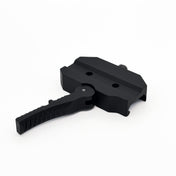
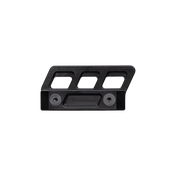
For prism scopes specifically — including the Saturn 4x32 — you match the scope's built-in mount base to a riser if you need lower 1/3. Saturn ships with an integrated mount at absolute co-witness height by default. Adding the Saturn riser mount raises it into lower 1/3 territory, which is what most modern shooters prefer once they try it.
Same logic for the Mercury reflex sight — it uses an RMR-compatible footprint, so any RMR-pattern mount at your preferred height (1.41" absolute, 1.54" lower 1/3, or 1.93" NV) will work. Pick the mount, pick the sight, do the math once, and you're done.
Building an AR-15 optic setup and want the height right the first time?
Grab the Saturn riser mount for lower 1/3 co-witness, or pair with the Saturn + Mercury piggyback bundle. Lifetime warranty. 60-day money-back guarantee.
Shop Mounts & OpticsFrequently Asked Questions
What is the exact height of absolute co-witness on an AR-15?
Absolute co-witness places the optical centerline at 1.41" above the top of a standard AR-15 flat-top upper receiver rail. That number matches the height of a deployed AR-15 iron sight aperture, so the front sight post sits centered inside the optic's dot or reticle. Any variation more than about 0.02" pushes you out of true absolute.
Is lower 1/3 co-witness better than absolute for red dots?
For modern shooting styles, yes — lower 1/3 gives a cleaner dot with iron sights out of the way and encourages a heads-up posture that speeds up scanning and target acquisition. Absolute still wins if you plan to run iron sights as an active backup or shoot heavy prone. Sales data shows lower 1/3 outsells absolute roughly 3-to-1 in 2025.
What height mount do I need for night vision?
You need a 1.93" mount, sometimes labeled "T1 tall" or "unity height," to raise the optic to eye level when using a PVS-14 or similar helmet-mounted night vision. Standard absolute (1.41") and lower 1/3 (1.54"-1.63") mounts sit too low, forcing the shooter to break cheek weld and hunt for the dot behind the NV tube.
Can I use a prism scope like the Saturn with lower 1/3 co-witness?
Yes — the Saturn 4x32 prism scope ships at absolute co-witness height by default, and the Saturn riser mount raises it into lower 1/3. Most piggyback-setup shooters who stack a Mercury red dot on top of the Saturn prefer the lower 1/3 configuration because it gives cleaner primary and secondary eye positions without a chicken-neck head tilt.
Does mount height affect zero or accuracy?
Mount height changes your "height over bore" — the vertical distance from the center of the barrel to the center of the optic — which affects mechanical offset at close range. A lower 1/3 mount at ~2.4" HOB puts your point of impact roughly 2.4" below your point of aim at 3 feet. It doesn't affect group accuracy or zero retention on a properly torqued mount.
What's the difference between "low mount," "absolute co-witness," and "lower 1/3"?
"Low mount" is a generic term for any mount below 1.4" and is uncommon on modern AR-15s. "Absolute co-witness" is the specific 1.41" height that matches AR-15 iron sights. "Lower 1/3" is 1.54"-1.63", pushing irons into the bottom third of the optic window. All three describe different optical centerline heights above the rail.
The Bottom Line
Absolute co-witness at 1.41" is the traditional answer — iron sights and optic share the same eye position, backup redundancy is instant, and cheek weld stays low. Lower 1/3 at 1.54"-1.63" is the modern answer — cleaner sight picture, heads-up posture, faster target transitions. Neither is objectively better; they're built for different priorities.
For a general-purpose AR-15 in 2026 — home defense, range work, occasional hunting — lower 1/3 is the safer default. It's what 74% of new mount buyers pick, what most trainers recommend, and what stacks cleanly with piggyback red-dot setups. If you're setting up a duty rifle where iron sights are part of the plan, or you shoot prone precision often, absolute is still the right call. Match the mount height to how you actually shoot, learn how to zero your optic correctly at that height, and the sight picture will feel right the first time you shoulder the rifle.

 https://cosmictactical.com