
Key Takeaways
- The AR-15 optics market is projected to top $1.2 billion in 2026, with red dot sights alone reaching $787M and growing 6.4% annually (Global Market Statistics, 2026).
- Your ideal AR-15 optic comes down to three questions: engagement distance, dominant use case, and whether you have astigmatism.
- A quality prism scope like the Saturn 4x32 now delivers ACOG-class performance at roughly one-quarter the price — the biggest shift in this category since MOA-adjustable red dots hit the mass market.
- Piggyback setups (magnified + red dot on the same rifle) have moved from SOF-only setups to mainstream duty rigs — expect to see them dominate 3-Gun and patrol carbines in 2026.
Picking the right optic for an AR-15 in 2026 is not a small decision. You've already spent $800 to $2,000 on the rifle. Whatever you bolt onto the top rail decides whether that platform actually delivers on close-quarters speed, mid-range accuracy, or both. And the market keeps expanding — new reticles, new mounting standards, new price points every quarter.
Here's the honest version: most of what's written about "best AR-15 optics" is either a re-skinned affiliate roundup or a mall-ninja hype piece. This buyer's guide skips both. We'll walk through what actually matters — glass, reticle, durability, mount system, use case — and lay out the specific picks that hold up under real-world conditions in 2026.
If you're a first-time buyer, start here. If you've owned three optics already, this is where you decide whether to upgrade or build a piggyback rig.
What Makes a Great AR-15 Optic in 2026?
According to industry research, the global red dot sight segment alone hit $787 million in 2026, growing at 6.4% CAGR — driven almost entirely by AR-15 platform demand and law enforcement adoption. That growth has forced manufacturers to compete on real performance, not just brand names.
A quality AR-15 optic in 2026 clears four bars, no exceptions:
- Holds zero under recoil and rough handling. This is table stakes. If it can't survive a drop off a bench or 500 rounds of 5.56 without POI shift, it doesn't belong on a fighting rifle.
- Reticle matches your engagement window. A 65 MOA circle-dot is fantastic at 25 yards and useless at 300. A BDC chevron is dialed for mid-range and slow for CQB. Pick the tool for the job.
- Glass and coatings that work in real light. Multi-coated lenses, high light transmission, and — if you're looking at magnified optics — a bright, etched reticle that stays visible without electronics.
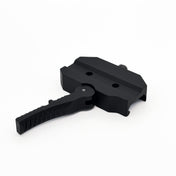
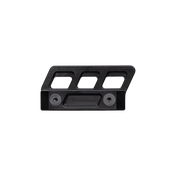
- A mount system that returns to zero. Most optic failures are actually mount failures. Quick-detach mounts like the Titan QR mount keep zero across removal cycles, which matters if your rifle sees case-to-range transport.
Miss any of these four and you'll be shopping again in six months. Nail all four and the optic outlasts the rifle.
What Is the Best Overall AR-15 Optic in 2026?
For general-purpose AR-15 use — hunting, tactical training, range work, home-defense carbines, and the "one rifle, one optic" build — a 4x fixed magnification prism scope is the closest thing to a right answer this category offers. And in 2026, the Cosmic Tactical Saturn 4x32 is our pick.
The reason isn't hype. A well-built 4x prism scope works out to 300 yards, handles CQB with both eyes open, and — critically — uses an etched glass reticle that stays visible even if the battery dies. That last point matters more than most guides admit. Battery failure is the number one cause of "my optic isn't working" complaints on AR forums, and an etched reticle sidesteps it entirely.
Where the Saturn earns the top slot:
- ACOG-class performance at $299.95. A Trijicon ACOG TA31 retails for $1,600 to $2,100. The Saturn covers the same use cases — magnified precision plus fast target acquisition — at roughly 15% of the cost. See our Saturn vs. ACOG head-to-head for the specs comparison.
- Etched, illuminated chevron reticle. Works in daylight without power. Fiber-optic + battery illumination for low light. BDC calibrated for either .223/5.56 or .308/7.62.
- Third-party lab certified. Shock, water (to 33 ft.), dust, and extreme temperature tested. This isn't marketing copy — the cert doc lives on the product page.
- Astigmatism-friendly. The etched reticle stays crisp even for shooters who see red dots as starbursts. Roughly 40% of adults have some degree of astigmatism (Zhang et al., 2023), so this isn't a niche benefit.
Where it doesn't fit: If you need variable power (say, hunting at 500+ yards), grab an LPVO. If you're building a pistol-caliber carbine for tight indoor spaces, skip magnification entirely and go reflex. The Saturn is fixed 4x — that's its job.
Learn more: why 4x32 is the ultimate AR-15 magnification and how to zero a prismatic scope.
What's the Best Reflex Sight for an AR-15?
Reflex sights own the close-quarters game. Home defense, PCC builds, entry-length ARs, three-gun stages — anywhere targets show up under 100 yards and the shot clock is running, a red or green dot beats magnified glass every time. And unlike prism scopes, they work for any shooter regardless of dominant-eye setup.
For 2026, the pick is the Cosmic Tactical Mercury. Here's why it lands above the pack:
- 4 selectable reticles. Most reflex sights lock you into one pattern. The Mercury lets you toggle between a 3 MOA dot, a 65 MOA circle-dot, and two hybrid patterns — meaning one sight covers CQB, transition drills, and mid-range dot work.
- 3-year battery life with motion activation. Sits dormant on your rifle in the safe, wakes when you pick it up, sleeps after 5 minutes idle. No dead battery when it counts.
- IP68 waterproof. 3 meters, 30 minutes. Duty-rig territory, not just "it survived rain once."
- RMR footprint. Fits standard RMR mounts and slide cuts. Also fits directly on top of the Saturn if you're building a piggyback rig.
- Assembled and tested in Texas. Every unit goes through final assembly and QC in Texas — one of the few sub-$300 optics you can say that about.
Available in black with either red or green dot. If you have mild astigmatism, the green dot variant often prints cleaner than red — worth trying before you write off reflex sights entirely.
Related reading: red dot vs. prismatic scope, and our plain-English guide to what a reflex sight actually is.
Best Piggyback Setup: Saturn + Mercury Combo
Piggyback mounting — a magnified optic with a small reflex sight riding on top — used to be exotic gear reserved for special operations. In 2026, it's mainstream. 3-Gun shooters use it to skip magnification changes on stage transitions. Patrol officers run it because ranges vary wildly on any given call. Home defenders like the flexibility of "one rifle, two use cases."
The Saturn + Mercury Piggyback Bundle exists specifically for this build. It ships with the Saturn 4x32, the Mercury reflex, and the RMR plate that mounts the Mercury directly on top of the Saturn body. Total price: $499.95 — roughly $100 less than buying the pieces separately.
What you get in practice:
- Precision at 100–300 yards through the Saturn's magnified etched chevron.
- Sub-second target transitions inside 25 yards by tilting the rifle slightly to catch the Mercury's dot.
- Zero re-mounting between the two — they share a rifle, but each holds its own zero.
- Redundancy. If the Mercury battery dies, the Saturn still works. If the Saturn takes damage, the Mercury still puts rounds on target.
This is the setup we recommend for any shooter running one AR-15 that has to cover more than one job.
Saturn vs. Mercury vs. Piggyback vs. LPVO: Side-by-Side Comparison
Here's how the three Cosmic Tactical picks stack up against a typical mid-tier LPVO — the four optic categories most AR-15 owners actually cross-shop in 2026.
| Optic | Type | Best Range | Magnification | Best For | Astigmatism-Friendly | Price |
|---|---|---|---|---|---|---|
| Saturn 4x32 | Prism scope | 100–300 yd | 4x fixed | Precision, hunting, one-rifle builds | Yes (etched reticle) | $299.95 |
| Mercury Reflex | Reflex sight | 0–100 yd | 1x (none) | Home defense, PCC, CQB, 3-Gun | Partial (green variant) | $249.95 |
| Piggyback Bundle | Prism + reflex | 0–300 yd | 4x + 1x | Duty, patrol, multi-role builds | Yes | $499.95 |
| Typical 1-6x LPVO | Variable scope | 25–500 yd | 1-6x variable | Long-range hunting, competition | Yes (etched) | $600–$1,800 |
The pattern is straightforward: reflex under 100 yards, prism from 100 to 300, piggyback if you need both, LPVO only when you routinely shoot past 300 or need continuous variable power. Price scales with capability, but so does weight and complexity — a fact most "gear reviews" leave out.
Best Budget-Friendly LPVO Alternative
Low-power variable optics (LPVOs) — the 1-6x or 1-8x scopes — dominate mid-tier AR-15 builds in 2026. They're versatile: true 1x on the low end for reflex-style shooting, magnified on the top end for precision. The catch: a quality LPVO from Vortex, Primary Arms, or SIG runs $600 to $1,800, and the true 1x at the low end is often "true-ish" — enough distortion to slow you down against a good dot.
For most AR-15 owners, a fixed 4x prism scope like the Saturn plus a co-witnessed reflex sight delivers 90% of LPVO capability at 40% of the cost. The rare use case where an LPVO genuinely wins is when you need continuous variable magnification — say, hunting where distances shift between 30 yards and 400 yards on the same stalk.
If you're on the fence, our detailed 4x32 vs. 1-6x LPVO breakdown covers when each setup wins.
What's the Best AR-15 Optic for Home Defense?
Home defense engagement distances rarely exceed 25 yards. Any magnified optic is overkill and actively slows you down under stress. The right pick is a reflex sight with a large field of view, generous eye box, and a reticle that's fast to find in dim lighting.
The Mercury handles this role directly. Set brightness on level 2 or 3 (not maxed out — that causes bloom, especially with astigmatism), zero at 25 yards using a 50/200 Improved Battle Sight Zero, and mount as low as possible with proper cheek weld. Motion activation means the sight wakes when you grab the rifle — no lost seconds pressing a power button in the dark.
A note on lights and lasers: if you're building a dedicated home-defense AR, budget for a weapon light before you upgrade the optic. Positive target identification matters more than a fancier dot. A Mercury reflex sight plus a quality 800-lumen light on a QD mount covers 99% of home defense scenarios.
How to Choose the Right AR-15 Optic (Decision Framework)
Skip the paralysis. Answer these four questions in order and you'll land on the right optic in under two minutes.
1. What's your maximum realistic engagement distance?
- Under 100 yards: Reflex sight. Get a Mercury.
- 100–300 yards: Prism scope. Get a Saturn.
- Mixed 25–300 yards, one rifle: Piggyback. Get the bundle.
- 300+ yards regularly: LPVO or dedicated precision optic (different guide).
2. Do you have astigmatism?
- Yes, significant: Etched reticle. Prism scope wins. Skip the red dot.
- Yes, mild: Try a green dot first; upgrade to prism if it still smears.
- No: Pick based on distance.
3. What's the rifle's primary role?
- Hunting or precision practice: Magnified optic.
- Home defense or PCC: Reflex sight.
- Multi-role duty or competition: Piggyback.
4. What's your budget?
- Under $300: Mercury reflex, or Saturn (right at the top of that range).
- $300–$500: Saturn plus a QD mount or riser, or the piggyback bundle.
- $500–$1,000: Full piggyback with accessories, or a mid-tier LPVO.
- $1,000+: Premium LPVO or ACOG — but ask whether the extra spend really moves your hit rate.
Straight answer: for a shooter with a $300 budget who's picked "under 100 yards, home defense, no astigmatism, one rifle," the answer is the Mercury. For a shooter at $500 who says "100–300 yards, hunting, has astigmatism," it's the Saturn. Framework does the work.
Frequently Asked Questions
What magnification is best for an AR-15?
For most AR-15 use cases, fixed 4x magnification hits the sweet spot — usable inside 25 yards with both eyes open and precise enough for shots to 300+ yards. Variable optics (1-6x, 1-8x LPVOs) add flexibility but at 3–5x the price and added weight. Under 100 yards, magnification actively slows target acquisition — a reflex sight wins.
Is a red dot or a prism scope better for an AR-15?
Red dots (reflex sights) are faster in close quarters and lighter. Prism scopes offer magnification, etched reticles that work without batteries, and better performance for shooters with astigmatism. If your engagement window is mostly under 100 yards, pick a red dot. If it's 100–300 yards or you have astigmatism, pick a prism scope. If it varies, run both on a piggyback setup.
How much should I spend on an AR-15 optic in 2026?
Expect to spend at least $250 for an entry-quality optic that will hold zero. Sub-$100 optics fail under recoil and lose zero regularly. The $250–$500 range is where quality-to-price ratio peaks — the Saturn ($299.95) and Mercury ($249.95) both sit in that band. Above $1,000, you're paying for brand and marginal glass upgrades.
Do I need a magnifier for my AR-15 red dot?
Usually no — and it's often the wrong solution. A 3x magnifier behind a red dot adds weight, eye-relief limits, and about $200 in cost. For most shooters, a prism scope from the start is lighter, cheaper, and delivers better glass. Magnifiers make sense when you already own a high-end red dot and only occasionally shoot past 100 yards.
Will a Cosmic Tactical optic hold zero on a 5.56 AR-15?
Yes. The Saturn is third-party lab certified for shock, water, dust, and extreme temperature — the exact tests that predict zero retention. The Mercury is IP68 rated and RMR-footprint compatible. Both carry a lifetime warranty and a 60-day money-back guarantee, so if they don't hold up on your rifle, they come back.
Bottom Line The "best" AR-15 tactical optic depends on how you shoot, where you shoot, and what your eyes let you see. But the shortlist for 2026 is smaller than it looks. For general purpose and precision at 100–300 yards, the Saturn 4x32 prism scope is our top pick. For close-quarters speed and home defense, the Mercury reflex sight. For the shooter who wants both — one rifle, every distance — the Saturn + Mercury piggyback bundle covers the entire envelope for under $500.
Whatever you choose, buy once, mount right, zero at the right distance, and train on it. The best optic in the world is the one you can put on target under pressure — which is a training investment as much as a hardware one.
Questions on which setup fits your build? Reach out to our team — we're shooters too, and we'd rather help you pick the right optic once than upsell you into the wrong one.

 https://cosmictactical.com