Red Dot Not Working? 8 Common Failures and Range-Side Fixes
Key Takeaways
- Seven out of eight red dot "failures" aren't failures at all — they're a dead battery, a sleeping sight, a wrong brightness setting, or a loose screw. All four are fixable at the bench in under a minute.
- A CR2032 reads 3.0V fresh and is functionally dead for a red dot below about 2.8V open-circuit, long before a multimeter shows zero (CR2032 Voltage Chart). "It still has voltage" is not the same as "it still works."
- Optic mounting screws want 10–15 in-lbs and blue thread locker, re-checked at 200–300 rounds (Legion Precision). Most "won't hold zero" complaints trace back to a screw, not an optic.
- A dot that looks like a comma, a starburst, or a smear usually means astigmatism in your eye, not a defect in the sight. Roughly 40% of adults have it (Zhang et al., Optometry & Vision Science, 2023).
Your dot's gone. You're at the range, you've got a hundred rounds and two hours of daylight left, and the optic that worked fine last month is showing you nothing but an empty window. Now what?
Here's the good news: red dot sights are simple machines. An LED, a coated lens, a battery, and a mount. When one stops working, the cause is almost always in that short list — and most of the time it's the battery or a screw. Actual electronic failure is rare, and it's the last thing you should suspect, not the first.
This guide walks the eight failures we see most often, in the order you should check them. Each one gets a symptom, the three most likely causes, and a fix you can do at the bench with a multi-tool. Work top to bottom. You'll solve it before you get halfway down.
Start Here: The 60-Second Triage
Before you take anything apart, match your symptom to the failure number below. Diagnosing a red dot is a process of elimination, and running it in order saves you from pulling a perfectly good optic off a perfectly good mount.
| What you're seeing | Start at |
|---|---|
| No dot at all, any brightness setting | Failure #1, then #2 |
| Dot appears when you tap or shoulder the gun | Failure #3 |
| Dot is there but washed out in daylight | Failure #4 |
| Dot cuts out under recoil, then comes back | Failure #5 |
| Groups wander, zero won't stay put | Failure #6 |
| Turret clicks but impact doesn't move | Failure #7 |
| Dot looks smeared, doubled, or like a starburst | Failure #8 |
Across the support tickets we handle at Cosmic Tactical, battery-related causes — dead cells, backward installation, weak contact, and sights that were simply asleep — account for the clear majority of "my optic is broken" reports. Mount hardware is a distant second. Genuine electronic failure sits in the low single digits.
Failure #1: Dead Battery (The One It Usually Is)
Symptom: No dot at any brightness setting, no flicker, nothing.
Coin cells don't fade gracefully. A CR2032 sits near 3.0V for most of its service life, then drops off a cliff. Below roughly 2.8V open-circuit, most red dot emitters won't light at usable daylight brightness even though a multimeter still shows "good" voltage. That's why the swap-test beats the meter-test every time.
Three most likely causes:
- The cell is simply exhausted — especially if you've been running max brightness or left the sight on.
- The battery is old stock. Coin cells self-discharge on the shelf, and a bargain 10-pack that sat in a warehouse for three years starts life half-dead.
- Cold. Lithium coin cells lose meaningful capacity below freezing. A battery that works at 70°F can go dark at 20°F and come back when it warms up.
Fix it in 60 seconds: Swap in a known-good CR2032 from a sealed pack — not the loose one rolling around your range bag. Positive side up unless your manual says otherwise. If the dot returns, you're done. Buy name-brand cells (Duracell, Energizer, Panasonic) and check the date code before you buy.
Sights with a top-loading battery tray, like the Mercury Reflex Sight, let you do this without removing the optic — which means you don't lose zero doing routine maintenance. Side- and bottom-loading designs force you to unmount, swap, remount, and re-zero. That's the difference between a 30-second fix and an afternoon.
Failure #2: Battery Is In, but the Sight Still Won't Light
Symptom: Fresh battery installed, still no dot. Or the dot flickers on when you press down on the battery cap.
This is a contact problem, not a power problem. The cell has to sit flat against a spring contact with enough tension to stay connected under recoil. Anything between the cell and the contact — oil, a fingerprint, a film of corrosion — breaks the circuit.
Three most likely causes:
- Installed upside down. Sounds obvious. It's still one of the most common causes we see. Positive (+, flat, marked) side faces up in most tray designs.
- Contamination on the contacts. Skin oils from handling the cell bare-fingered, gun oil that wicked into the tray, or green/white corrosion crust from moisture.
- Weak contact spring or an over-torqued cap. A cap cranked down past spec can deform the tray; a cap that isn't seated leaves the cell floating.
Fix it in 60 seconds: Pull the cell. Wipe both faces and the contact surfaces with a dry patch or an alcohol wipe, then reinstall without touching the flat faces. Snug the cap firmly by hand — firm, not gorilla-tight. If the dot only appears while you press the cap, the spring has lost tension and the optic needs service.
Failure #3: The Sight Is Asleep, Not Dead
Symptom: No dot when you pick up the gun, but it appears the moment you tap the optic or shoulder the rifle.
That's not a failure. That's the sight doing exactly what it was designed to do. Motion-activation systems put the emitter to sleep after a set idle period — five minutes on the Mercury — and wake it on the first hint of movement. It's how a CR2032 stretches to a three-year service life instead of dying in a month.
Three most likely causes:
- Motion activation has timed out and the sight is in standby.
- The optic is in a padded case or safe where nothing has jostled it in days.
- A manual auto-off timer (common on 4- to 12-hour shutoff designs) has expired and needs a button press to reset.
Fix it in 60 seconds: Tap the housing or shoulder the gun. If the dot snaps on, nothing is wrong. If you'd rather it stay lit — during a class, a match stage, or a night on the nightstand — press any brightness button to force it awake and confirm your manual's wake behavior.
We've had customers ship optics back for warranty evaluation that turned out to be working perfectly. They'd pulled the gun from a safe, seen a dark window, and assumed the worst. Shake test first. It costs you two seconds and saves a two-week RMA.
Failure #4: Dot Is Dim, Faint, or Washed Out in Daylight
Symptom: The dot's there, but you can barely find it against a bright target or a snow-covered berm.
Ambient light is the variable most shooters forget. A brightness setting that's crisp in an indoor bay disappears at noon on an open range. Most quality sights ship with 8 or more daylight settings plus at least one night-vision level, and the NV settings are invisible to the naked eye by design.
Three most likely causes:
- You're on an NV setting. If your sight has 9 levels and one is NV-compatible, cycling past the top can drop you to the bottom of the range.
- Lens contamination. Fingerprints, sunscreen, bug spray, or carbon film on the front lens or the emitter window scatter the beam and eat brightness.
- Battery is on its way out. A dying cell loses top-end brightness first, before it loses the dot entirely. If your max setting looks like your old medium setting, replace the battery.
Fix it in 60 seconds: Cycle to maximum brightness and confirm you're not wrapped around to an NV level. Clean both lens surfaces with a microfiber cloth and lens fluid — never a shirttail, never solvent. If max brightness still looks weak, go back to Failure #1.
One overlooked culprit: anti-reflective devices. A killflash or honeycomb ARD cuts glare signature, but it also cuts light transmission through the objective. If you added an ARD and your sight picture got dimmer the same week, that's not a coincidence — pull it and re-check before you blame the optic.
Failure #5: Dot Flickers or Cuts Out Under Recoil
Symptom: The dot's solid at rest, then blinks out on the shot and returns a second later.
Recoil flicker is a mechanical problem masquerading as an electrical one. The impulse momentarily breaks the battery-to-contact connection, the LED loses power for a few milliseconds, and your brain reads it as a flash. Every time. It's the most misdiagnosed symptom on this list.
Three most likely causes:
- Loose battery cap or a cell that doesn't fill the tray. Off-spec or thin third-party cells leave slack the spring can't take up under recoil.
- Corroded contacts. Moisture ingress leaves a resistive film that holds a connection at rest and breaks it under shock.
- Moisture inside the housing. If your sight has fogged internally or shows condensation between lenses, the seal has failed — and that's an RMA, not a range fix.
Fix it in 60 seconds: Re-seat the cell, clean the contacts, and snug the cap. Then dry-fire or rack the action and watch for flicker. If it persists with a fresh name-brand cell and clean contacts, the sight needs warranty service.
Sealing standard matters more here than most spec sheets admit. IPX7 covers 1 meter of water for 30 minutes. IP68 covers 3 meters for 30 minutes and adds dust ingress protection — the two conditions that actually put moisture on a contact. The Mercury is IP68-rated and nitrogen-purged, which is why humidity swings don't fog it from the inside.
Failure #6: Dot Works, but the Rifle Won't Hold Zero
Symptom: Groups open up, point of impact drifts between range sessions, or your zero walks over a string of fire.
This is a fastener problem in the overwhelming majority of cases. Optic mounting screws want 10–15 in-lbs depending on platform and manufacturer, plus blue thread locker, and they should be re-checked after the first 200–300 rounds (Legion Precision). Correctly torqued screws can still vibrate loose without a thread locker holding them (Boss Components).
Three most likely causes:
- Under-torqued or un-Loctited optic screws. Hand-tight with a multi-tool isn't a torque spec. It's a guess.
- Loose mount-to-rail interface. The optic can be tight to the mount while the mount itself walks on the rail. Check both joints.
- Ammunition, not hardware. Switching loads changes point of impact. Verify with the same lot you zeroed with before you tear anything down.
Fix it in 60 seconds: Grab the optic body and try to twist it against the mount, then grab the mount and try to twist it against the rail. Any movement at all is your answer. Degrease the threads, apply blue thread locker, torque to the manufacturer's spec with an actual torque driver, and let it cure 24 hours before live fire.
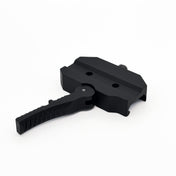
A quality quick-detach mount like the Titan QD returns to zero on re-installation, which takes the mount out of the suspect list entirely. Once the hardware is settled, walk back through the zeroing process from scratch rather than chasing the drift with turret clicks.
Failure #7: Turrets Click but the Impact Doesn't Move
Symptom: You're adjusting windage or elevation, the clicks feel normal, and the group stays put.
You've likely run out of adjustment travel. Every optic has a finite internal range, and once the mechanism bottoms out the turret can still turn while the reticle stops moving. It feels like a broken adjustment. It's usually a mounting geometry problem instead.
Three most likely causes:
- Adjustment range exhausted. Common when the optic is compensating for a canted rail or an aggressive mount height mismatch.
- Turret cap binding. A cap threaded down onto the adjustment screw can prevent the detent from engaging cleanly.
- You're testing at the wrong distance. One MOA at 25 yards is a quarter inch. Four clicks that move a group a hair at 25 look like nothing on paper.
Fix it in 60 seconds: Count clicks back to mechanical center — run the turret to one stop, count all the way to the other, then return half. If your zero requires more travel than the optic has, the fix is a different mount height or a shimmed base, not more clicking. Verify at 50 or 100 yards where the adjustment is actually visible.
Getting mount height right the first time avoids this entirely. Absolute co-witness and lower 1/3 co-witness put the optic at meaningfully different heights over bore, and the wrong choice eats adjustment range you'll want later.
Failure #8: The Dot Looks Smeared, Doubled, or Like a Starburst
Symptom: The dot isn't round. It's a comma, a starburst, a smear, or a cluster of dots — and it looks that way to you but fine to your buddy.
Here's the part nobody tells you at the gun counter: that's your eye, not the optic. Astigmatism distorts point light sources, and a red dot is the purest point light source you'll ever look at. Roughly 40% of adults have some degree of astigmatism (Zhang et al., Optometry & Vision Science, 2023), and most of them have never had it flagged because it doesn't affect daily vision much.
Three most likely causes:
- Uncorrected astigmatism. The give-away: hand the gun to someone else and the dot looks perfectly round to them.
- Brightness set too high. Even mild astigmatism gets dramatically worse as the emitter is cranked up. Dial down and the smear often shrinks to a usable dot.
- Contaminated or damaged lens coating. If the distortion also shows on distant point lights through the optic — streetlights, stars — clean the lens and inspect the coating.
Fix it in 60 seconds: Turn the brightness down two or three clicks. Try it with corrective lenses if you have them. If the dot cleans up, you've confirmed astigmatism, and you've got a decision to make about optic type rather than a repair to schedule.
An etched reticle solves this permanently. Prism scopes like the Saturn 4x32 use a reticle physically etched into the glass — the illumination just adds color to a shape that's already there, so an astigmatic eye sees a crisp chevron instead of a bloomed smear. If you've bounced between three red dots chasing a clean dot, read our red dot vs. prismatic scope breakdown before you buy a fourth.
What If None of These Fixed It?
If you've swapped the battery, cleaned the contacts, confirmed the sight isn't asleep, run the brightness range, checked every screw, and the dot still won't behave, you're in the small minority with an actual hardware failure. Emitters do die. Seals do fail. It's rare, but it happens.
Before you call anyone, write down four things: what the symptom is, what conditions trigger it, what you've already ruled out, and the round count on the optic. That turns a two-week back-and-forth into a single phone call.
Cosmic Tactical optics carry a no-BS limited lifetime warranty and a 60-day money-back guarantee. If a Mercury or Saturn fails, we replace it. No proof of purchase gymnastics, no "normal wear" runaround.
How to Prevent Six of These Eight Failures
Most of this list is preventable with about ten minutes of maintenance a year. Here's the short version:
- Change the battery on a schedule, not on a failure. Pick a date — first of the year, opening day, whatever sticks — and swap it whether it needs it or not. A CR2032 costs less than a box of ammo.
- Keep a spare cell taped inside your rifle case. Sealed, name-brand, replaced annually.
- Torque your screws with a torque driver and blue thread locker, then re-check at 200–300 rounds.
- Clean the lenses with a microfiber cloth — not your sleeve, not brake cleaner.
- Confirm zero after any transport, drop, or mount removal. Three rounds at 50 yards is enough.
- Buy sealed. IP68 and nitrogen purging aren't marketing — they're what keeps moisture off the contacts that cause flicker in the first place.
Frequently Asked Questions
How do I know if my red dot battery is dead or the sight is broken?
Swap in a sealed, name-brand CR2032 before anything else. A coin cell can read close to 3.0V on a meter and still fail to drive an emitter below roughly 2.8V open-circuit. If a fresh cell brings the dot back, the sight was never broken — and battery causes account for most "dead optic" reports we handle.
Why does my red dot flicker when I shoot?
Recoil flicker is almost always a battery contact issue, not an electronic one. The impulse breaks the cell-to-contact connection for a few milliseconds. Re-seat the battery, clean both contact surfaces, and snug the cap. If it still flickers with a fresh cell and clean contacts, the seal or the internal contact has failed and it needs warranty service.
Why does my red dot look blurry or like a starburst?
That's astigmatism in your eye, not a defect in the optic — roughly 40% of adults have some degree of it (Zhang et al., 2023). Confirm it by having someone else look through the same sight. Turning brightness down helps. An etched-reticle prism scope fixes it permanently.
How tight should red dot mounting screws be?
Between 10 and 15 in-lbs depending on platform, with blue thread locker and a 24-hour cure before live fire (Legion Precision). Always defer to your optic manufacturer's published spec first. Re-check torque after the first 200–300 rounds, then periodically. Never use red permanent thread locker on an optic screw.
My red dot turns off by itself. Is it defective?
Probably not. Motion-activated sights sleep after an idle period to preserve battery life — five minutes on the Mercury, which is how a single CR2032 stretches to a three-year service life. Tap the housing or shoulder the gun. If the dot returns instantly, the sight is working as designed.
Bottom Line
Run the list in order and you'll fix most red dot problems in under five minutes: battery, contacts, sleep mode, brightness, flicker, screws, travel, eye. Only that last handful of cases is a real hardware failure, and a lifetime warranty exists precisely for those.
The design choices that prevent these headaches are worth paying attention to when you buy. Top-loading batteries mean you never break zero to change a cell. IP68 sealing keeps moisture off the contacts that cause flicker. An RMR-standard footprint means your mounting options stay open instead of collapsing to one proprietary plate. The Mercury Reflex Sight ships with all three at $249.95, assembled and tested in Texas.
Still stuck after working the list? Get in touch — tell us the symptom and what you've already ruled out, and we'll tell you straight whether it's a fix or an RMA. We shoot too. We'd rather solve it than sell you something you don't need.

 https://cosmictactical.com