Key Takeaways
The Vortex SPARC AR and the Cosmic Tactical Mercury both get pitched as entry-level red dots, but they're not the same tool. The SPARC AR is a tube sight with an integrated multi-height riser built for one job: sitting on an AR-15 flattop. Street price runs $169.99–$199.99, it's backed by Vortex's unconditional VIP warranty, and multiple retailers now list it as discontinued. The Mercury is a $249.95 open-emitter reflex on the RMR footprint — four selectable reticles, IP68 sealing, a three-year top-loading CR2032, and assembly in Texas — that moves between a pistol slide, a PCC, a shotgun, or a rifle. If you want the cheapest way to put a dot on one AR and never touch it again, buy the SPARC AR. If you want one sight that follows you across platforms, the Mercury is the better buy.Mercury vs Vortex SPARC AR: What Are You Actually Choosing Between?
Search "budget AR red dot" and you'll get the SPARC AR and the Mercury in the same list, usually ranked as if they're interchangeable. They aren't. One is a 22 mm tube sight bolted to a fixed riser. The other is a micro reflex on the industry-standard RMR footprint.
That distinction decides most of this comparison before you ever look at a spec sheet. So we're going to start there instead of burying it under a table.
The U.S. riflescope and red dot market is projected to reach $4.51 billion by 2034, with entry-tier optics driving most of the unit volume (Polaris Market Research). More shooters are buying their first dot than at any point in the last decade, and most of them are choosing between exactly these two categories without knowing there's a category choice being made.
Specs at a Glance: Mercury vs Vortex SPARC AR
| Spec | Cosmic Tactical Mercury | Vortex SPARC AR |
|---|---|---|
| Price | $249.95 | $169.99–$199.99 street ($279.99 MSRP) |
| Type | Open-emitter reflex | Enclosed tube red dot |
| Footprint / Mount | RMR-compatible (riser or plate needed for rifle) | Integrated multi-height Picatinny mount (included) |
| Reticle Options | 4 selectable configurations | 1 (fixed 2 MOA dot) |
| Dot Size | 3 MOA | 2 MOA |
| Dot Color | Red or Green (choose at purchase) | Red only |
| Brightness Levels | 9 (8 daylight + 1 NV) | 10 (8 daylight + 2 NV) |
| Battery | CR2032 (top-loading) | AAA (side compartment) |
| Battery Life | Up to 3 years (~26,000 hrs) | 50,000 hrs (2019 LED version); 300–5,000 hrs (original) |
| Auto On/Off | Motion activation (wakes on movement, sleeps at 5 min) | 12-hour auto shutdown (no shake-awake) |
| Weather Sealing | IP68 (3 m / 30 min) | O-ring sealed, nitrogen purged (no IP rating published) |
| Adjustment | 1 MOA per click | 1 MOA per click (90 MOA total travel) |
| Weight | Micro reflex class (sight only) | 8.6 oz with mount |
| Made In | Assembled & tested in Texas, USA | Not published by Vortex |
| Warranty | Limited Lifetime + 60-day money back | VIP: unlimited, unconditional, transferable |
| Current Status | In production | Listed as discontinued by multiple retailers |
Sources: Vortex Optics for SPARC AR specifications; Cosmic Tactical product data for the Mercury.
Tube Sight or Open Reflex: Which Form Factor Do You Actually Need?
This is the question the spec table can't answer, and it's the one that matters most. The SPARC AR is an enclosed 22 mm tube with a fixed riser. The Mercury is an open-emitter reflex with an RMR footprint. Neither design is better in the abstract — they solve different problems.
An enclosed tube protects the emitter and the lens from rain, mud, and lint. Nothing gets between the LED and the glass because the glass is sealed inside a housing. The tradeoff is bulk: 8.6 ounces with the mount, a visible tube wall in your peripheral vision, and a form factor that only ever works on a rail.
An open reflex has no tube. You get an unobstructed sight picture and a fraction of the weight, but the emitter sits exposed at the bottom of the window. Rain droplets and heavy snow can occlude the dot until you wipe it. That's a real and honest limitation of the Mercury, and of every open reflex including the Trijicon RMR.
Our take: the SPARC AR can only ever be a rifle optic. The Mercury on the RMR footprint fits a pistol slide, a PCC, a shotgun rib, and a rifle riser. If you own more than one host, that flexibility is worth more than the $50–$80 price gap. If you own exactly one AR and it's never getting a different optic, the flexibility is worth nothing and the SPARC AR is the cheaper answer.
Almost every "best budget AR red dot" list ranks tube sights and micro reflexes against each other on dot size and battery hours. That's the wrong axis. The first question is how many guns the sight has to serve, and the second is whether the emitter needs to be enclosed. Price is third.
Why Does the SPARC AR Have Two Different Battery Ratings?
Because there are two SPARC ARs. Vortex maintains separate product pages: the original rates the AAA cell at up to 300 hours on max brightness and 5,000 hours on the lowest setting, while the 2019 LED-upgrade version rates it at 50,000 hours (Vortex Optics). Both carry the same SPC-AR2 model number in most listings.
Our finding: we pulled specs from six retailer listings for SPC-AR2 and found battery life quoted as 300 hours, 5,000 hours, and 50,000 hours — sometimes on the same page. MSRP was listed at $225, $259.99, and $279.99. If you're shopping the SPARC AR on price alone, confirm which generation the seller is actually shipping before you buy.
Third-party testing lands closer to the conservative end. Scopes Field measured roughly 320 hours at practical daylight brightness settings and noted the sight has no shake-awake, so it relies on a 12-hour auto shutdown you have to remember to work around (Scopes Field). The 50,000-hour figure describes the lowest usable setting, not the setting you'll actually run outdoors.
Battery Design: AAA vs CR2032
The SPARC AR runs a single AAA in a side compartment. The Mercury runs a CR2032 in a top-loading tray. Both cells cost under two dollars and both are stocked at any gas station in America, so availability isn't the differentiator here.
Chemistry is. Alkaline AAA cells leak when they sit discharged, and a leaking cell inside a sealed optic housing is how budget red dots die. Lithium coin cells like the CR2032 don't leak the same way. If your rifle spends eleven months a year in a safe, that difference matters more than any rated hour count.
From our support inbox: the single most common "my red dot is dead" ticket we handle isn't a failed emitter or a cracked lens. It's a corroded battery contact on an optic that sat for a season with a tired alkaline cell in it. Whichever sight you buy, pull the battery before long-term storage and swap it every January.
Top-loading matters too. The Mercury's tray faces up, so you change the cell without breaking zero or pulling the sight off the host. The SPARC AR's side compartment is accessible without dismounting as well, though Scopes Field flags it as less protected than a top-loading design. Neither requires the full removal that the original Trijicon RMR did.
Mounting on an AR-15: Where the SPARC AR Has a Real Edge
Out of the box, the SPARC AR is the easier AR build. It ships with a multi-height mount offering absolute co-witness and lower 1/3 co-witness, both correctly indexed for an AR-15 flattop (Vortex Optics). You get the sight, a hex key, and a working height over bore in one box for under $200.
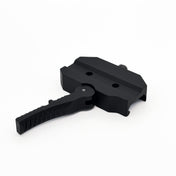
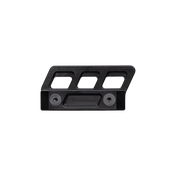
The Mercury needs a mount. On a pistol slide cut for an RMR it drops straight in, but on an AR flattop you're adding a riser or an RMR-pattern rail plate to reach a usable co-witness. That's an extra part, extra cost, and one more interface that has to be torqued correctly. We're not going to pretend otherwise — on a single-rifle build, the SPARC AR is genuinely simpler.
Where the Mercury earns that extra step back is what the RMR footprint unlocks. The same sight rides the Piggyback Bundle on top of a Saturn 4x32 prism scope, giving you 4x magnification for mid-range work and a red dot canted above it for CQB. No tube sight can do that; the SPARC AR's integrated riser is the wrong height and the wrong footprint for a piggyback stack. If you want that setup, start with a riser mount and plan the height over bore before you buy.
Dot Size, Reticles, and Brightness
The SPARC AR gives you one reticle: a fixed 2 MOA red dot across 10 brightness settings, the lowest two night-vision compatible. The Mercury gives you four selectable configurations, a 3 MOA dot in red or green, and 9 settings with one NV-compatible level.
At AR distances the MOA gap is smaller than the spec sheet suggests. A 2 MOA dot covers about one inch at 50 yards; a 3 MOA dot covers about 1.5 inches. Inside 100 yards, on a torso-sized target, both disappear into the noise of your trigger press. The 2 MOA dot is the better precision tool at 200 yards and beyond. The 3 MOA dot is faster to find under stress at seven yards.
Reticle selection is where the Mercury separates. Running a plain dot for zeroing and a circle-dot for close work changes how fast you index the sight, and you can switch without tools between stages or between hosts. A fixed 2 MOA dot is a perfectly good reticle — it's just the only one you get.
One caveat on green: shooters who see a red dot as a smear often see a green one more cleanly, and green reads better against brown and tan backgrounds. The SPARC AR has no green option. If a dot has ever looked fuzzy to you, that's worth reading up on before you buy either sight — see our breakdown of how red dots compare to prismatic scopes.
Durability and Weather Sealing
The Mercury carries a published IP68 rating: 3 meters of submersion for 30 minutes. Vortex describes the SPARC AR as O-ring sealed and nitrogen purged, waterproof and fogproof, but doesn't publish an IP number for it. That's not a knock on the hardware — nitrogen purging is the right approach for a sealed tube — but an unrated claim and a tested rating aren't the same evidence.
On impact resistance, Scopes Field reported reliable zero retention through 500+ rounds on the SPARC AR and praised the aluminum chassis, while noting slight dot bloom at maximum brightness (Scopes Field). Both sights are built to survive an AR-15's recoil impulse, which is modest compared to what a slide-mounted optic absorbs.
The Mercury is assembled and function-tested in Texas, which means every unit gets checked before it ships rather than sampled at a factory overseas. Vortex doesn't publish a country of manufacture for the SPARC AR line.
Warranty and Long-Term Support
Vortex wins this one outright, and it's not close. The VIP warranty is unlimited, unconditional, and fully transferable — no receipt, no registration, and it covers damage you caused. Cosmic Tactical's limited lifetime warranty covers defects, backed by a 60-day money-back guarantee, which is a normal industry warranty but not an unconditional one.
The complication is availability. Multiple retailers now list the SPARC AR as discontinued, with Vortex's SPARC line moving toward the solar-equipped model. VIP coverage survives discontinuation — Vortex honors it on out-of-production optics — but replacement mounts, spacers, and battery caps get scarce once inventory clears. If you buy a SPARC AR today, buy a spare mount screw set with it.
Where Each Sight Wins
Choose the Vortex SPARC AR If:
- You're building exactly one AR and want the cheapest complete solution. At $169.99–$199.99 with the mount included, nothing about this setup requires a second purchase.
- You want an enclosed emitter. If your rifle lives in rain, mud, or snow, a sealed tube keeps the dot visible when an open reflex needs a wipe.
- Unconditional warranty coverage is your priority. VIP covers user damage. That's genuinely rare and genuinely valuable.
- You want the tighter dot. 2 MOA beats 3 MOA for deliberate shots past 200 yards.
Choose the Mercury If:
- The sight needs to serve more than one gun. The RMR footprint moves between pistol, PCC, shotgun, and rifle. A SPARC AR moves between one rail and another rail.
- You want reticle options. Four selectable configurations versus one fixed dot, switchable without tools.
- Weight and sight picture matter. An open reflex weighs a fraction of 8.6 ounces and gives you no tube wall in your peripheral vision.
- You want green. Red or green at the same price, chosen at purchase.
- You want a tested waterproof rating and a sight still in production. IP68 to 3 meters, with parts and support available for the long haul.
- You're planning a piggyback build. The Mercury stacks on a Saturn 4x32. The SPARC AR can't.
Who Should Buy What: Practical Scenarios
First AR-15, Nothing Else in the Safe
The SPARC AR. One box, one price, a mount that's already the right height, and a warranty that covers you if you drop the rifle off a tailgate. If it's discontinued at your retailer, that's a reason to buy soon rather than a reason to avoid it. Edge: SPARC AR.
Home Defense Carbine
Close call. The SPARC AR's enclosed emitter is more forgiving if the gun sits untouched for months. The Mercury's motion activation means the dot is already lit when you pick it up, versus the SPARC AR's 12-hour auto shutdown that leaves you pressing a button first. For a nightstand gun, an always-ready dot is worth more than a sealed one. Edge: slight Mercury.
Pistol, PCC, or Shotgun
Not a contest. The SPARC AR doesn't mount to a slide, and its height over bore is wrong for a shotgun rib. The Mercury's RMR footprint is the standard these hosts are cut for. Edge: Mercury.
Magnified Plus Red Dot on One Rifle
The Mercury, through the RMR plate on the Saturn 4x32. If you want to understand whether magnification belongs on your build at all, our comparison of whether prism sights are worth it covers the tradeoffs. Edge: Mercury.
Duty or Hard-Use Rifle in Bad Weather
The enclosed tube wins on paper, but neither of these is a duty-tier optic at this price. If the rifle genuinely goes to work, budget for an enclosed emitter sight built for it. Edge: SPARC AR, with reservations.
The Honest Verdict
The SPARC AR is cheaper, and we're not going to argue otherwise. For a single AR-15 that will never wear a different optic, it's a sound buy with a warranty nobody in the industry beats.
The Mercury costs $50–$80 more and asks you to buy a mount. What you get back is a sight that isn't locked to one rifle, four reticles instead of one, a green option, a tested IP68 rating, USA assembly, and a footprint that still has a future. Over the life of a gun collection, that's the cheaper path.
Buy the SPARC AR for one gun. Buy the Mercury for the next five.
Frequently Asked Questions
Is the Vortex SPARC AR discontinued?
Multiple retailers now list the SPARC AR as discontinued, and Vortex's SPARC line has shifted toward the solar-equipped model. Remaining stock is still sold at $169.99–$199.99 against a $279.99 MSRP. The VIP warranty stays valid on discontinued optics, but replacement mounts and spacers become harder to source once inventory clears.
Why do listings show different battery life for the same SPARC AR?
Vortex produced two versions under the same model number. The original rates the AAA cell at 300 hours on maximum and 5,000 hours on the lowest setting. The 2019 LED-upgrade version rates it at 50,000 hours. Third-party testing measured roughly 320 hours at practical daylight brightness, so confirm which generation a seller is shipping.
Can the Mercury mount on an AR-15 like the SPARC AR does?
Yes, but it needs a separate riser or RMR-pattern rail plate to reach a usable co-witness height. The SPARC AR includes absolute and lower 1/3 co-witness mounts in the box. Budget an extra $25–$55 for Mercury mounting hardware on a rifle build, or start with the Piggyback Bundle if you also want magnification.
Is a 2 MOA dot meaningfully better than a 3 MOA dot?
Only at distance. A 2 MOA dot covers roughly one inch at 50 yards versus 1.5 inches for a 3 MOA dot — a difference that disappears inside 100 yards on a torso target. The 2 MOA dot is better past 200 yards; the 3 MOA dot is faster to acquire under stress at close range.
Which sight is better if I have astigmatism?
Neither, honestly. Both project an illuminated dot, and astigmatism can make either one look smeared or starburst-shaped regardless of brand or dot size. An etched reticle in a prism scope like the Saturn 4x32 stays sharp because the reticle is physically etched into the glass rather than projected onto it.
Does the Mercury's open emitter fail in rain?
It can be occluded by heavy rain or wet snow landing on the emitter, which is a limitation of every open reflex including the Trijicon RMR and Holosun 507C. A wipe clears it. The Mercury's IP68 rating covers submersion at 3 meters for 30 minutes, so water ingress isn't the concern — obstruction is.

 https://cosmictactical.com