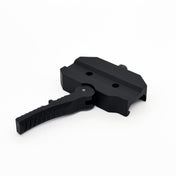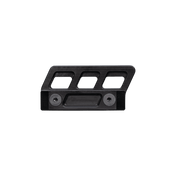

A red dot footprint is the pattern of screws, posts and recoil surfaces that an optic uses to attach to a slide, a plate or a mount. Get it wrong and the sight physically will not bolt down. There is no firmware fix, no shim, no "close enough."
This page is a reference, not a ranking list. Four patterns cover most of what you'll shop in 2026 — RMR, RMSc, ACRO and DeltaPoint Pro — and they fail to interchange in four different ways. Two share screw spacing but not optic size. One isn't a flat plate pattern at all. And the one most people associate with pistols has a second life on rifles that almost nobody writes about.
Key Takeaways
- RMR uses two mounting screws about 18.8 mm apart plus two recoil-lug sockets in the front corners roughly 22.5 mm apart (OpticFootprint, 2026).
- RMSc shares screw spacing with DeltaPoint Pro but not optic size — an RMSc cut is built around a ~40 mm optic and will not accept a ~46 mm full-size DPP.
- is not a flat-plate pattern. A single horizontal screw clamps the optic against an angled dovetail surface, so nothing in the screw-pattern family crosses to it.
- RMR on a rifle is the under-covered case: offset, co-witness and piggyback mounts are all built on the pattern, and the screws torque to 12 in-lb, not "tight."
- The handgun red dot market was worth $1.8 billion in 2025 and is projected to hit $3.2 billion by 2034 (Dataintelo, 2025) — which is why there are now more patterns than slide cuts.
What Is a Red Dot Footprint, Exactly?
A footprint is a mechanical interface defined by three things: screw spacing, the number and position of locating posts or sockets, and the overall envelope the optic body occupies. The RMR pattern, for example, specifies two screws roughly 18.8 mm apart and two front recoil-lug sockets about 22.5 mm apart, inside a base footprint near 45.7 × 24.1 mm (OpticFootprint, 2026).
All three have to match. Screw spacing alone is the trap — it's the one dimension everybody quotes, and the one that lies most often.
Two optics can share screw spacing and still refuse to seat, because the posts that locate the optic are a different diameter, or sit in different corners, or the optic body is simply longer than the pocket milled into the slide. The screws are what hold it down. The posts and the recoil surfaces are what stop it moving under recoil.
That distinction matters more on a pistol than a rifle. A slide-mounted optic takes a hard rearward slam on every shot, and the screws have only three or four threads of engagement to resist it. The locating features carry that load. Strip them and you've turned a $250 sight into a shear test.
What Are the Four Footprints You'll Actually Encounter?
Four patterns cover the large majority of current production optics, and each one was designed around a different class of host gun. RMR came from full-size and compact double-stack pistols. RMSc came from slim single-stacks. DeltaPoint Pro landed on 1911s and SIG P320 variants. ACRO came from enclosed-emitter duty sights (Shooting Illustrated, 2026).
| Footprint | Interface | Typical optic envelope | Built for |
|---|---|---|---|
| RMR | Two screws (~18.8 mm) + two front recoil-lug sockets (~22.5 mm) | ~45.7 mm long | Full-size and compact double-stacks; rifle mounts |
| RMSc | Two screws + four corner sockets, narrow pattern | ~40 mm long | Slimline and micro-compact carry pistols |
| DeltaPoint Pro | Two screws + cross-slot recoil bar; 4.2 mm locating posts | ~46 mm long | 1911, 2011, P320, competition slides |
| ACRO | One horizontal clamp screw against an angled dovetail | Enclosed "mailbox" body | Enclosed-emitter duty sights |
Sources: OpticFootprint for RMR screw and lug spacing and DeltaPoint Pro post diameter; Shooting Illustrated for the ACRO clamp description and host-gun categories.
Before writing this we pulled the pages currently ranking for footprint queries and compared their numbers against each other. They disagree. One reference puts RMR screw centerline at 18.8 mm; another quotes it as 0.92 in, which is 23.4 mm. Both are published, both are cited, and they describe the same pattern. That gap is the single best argument for identifying your cut by pattern and host gun rather than by a number you read in a chart.
Which Footprints Actually Interchange?
RMSc, DeltaPoint Pro and Holosun K overlap heavily and still catch people out. Holosun's K pattern is effectively the Shield RMSc pattern with the rear recoil-lug recess removed and shorter front posts (OpticFootprint, 2026). The screw holes line up on an RMSc cut. The optic may still not sit flat.
The DeltaPoint Pro problem is size, not holes. RMSc-class micro optics run about 40 mm long; full-size RMS and DeltaPoint Pro bodies run up to about 46 mm. A slide milled around a 40 mm optic has a 40 mm pocket. Six millimetres of overhang is six millimetres you can't machine away at the range.
So what does cross cleanly? Within the RMR family, a great deal. RMR-pattern optics from several makers share plates, mills and mounts, which is the practical reason the pattern stayed dominant. Between families, essentially nothing crosses without an adapter plate — and a plate raises the sight, adds a screwed interface, and has to be the right plate.
That reasoning is why the $249.95 Mercury reflex sight is built on the RMR footprint instead of something proprietary. A footprint decision shouldn't lock an optic to one gun. If you want the optical side of the choice rather than the mechanical one, our red dot vs. prismatic scope comparison covers that ground.
Why ACRO Doesn't Belong in a Footprint Chart
The ACRO interface works nothing like the others. A single horizontal screw draws the optic against an angled surface, clamping it much the way a Picatinny mount clamps a rail (Shooting Illustrated, 2026). There are no vertical screws passing down through the optic into a plate.
Which means ACRO isn't a footprint in the same sense as the other three, and putting it in a four-column comparison chart quietly misleads people. The other patterns answer "where are the holes?" ACRO answers "what shape is the rail?" You cannot adapt between a hole pattern and a clamped dovetail with a flat plate, because a flat plate has nowhere to clamp. You need a purpose-built ACRO mount or an ACRO-cut slide. Full stop.
One further trap: enclosed does not mean interchangeable. The Holosun 509T and EPS are enclosed-emitter sights too, and each uses its own Holosun pattern rather than the ACRO interface. Shoppers reasonably assume "enclosed emitter" is a category with a shared mount. It isn't.
What Does the RMR Footprint Mean on a Rifle?
This is the part the footprint guides skip. The RMR pattern is used on pistols and on rifle mounts designed around it (OpticFootprint, 2026), and once the optic leaves a slide, the whole fitment conversation changes. There's no slide cut, no adapter plate number, no MOS chart. There's a Picatinny rail and a mount that happens to speak RMR.
Three configurations cover most rifle use. A 45-degree offset mount puts the dot beside a magnified optic so you roll the rifle to transition — Trijicon sells an RMR-footprint 45° rail offset adapter for exactly that. A direct rail mount sets the dot on the top rail at a chosen height. And a piggyback plate stacks it above a magnified optic.
Height is the variable that replaces plate numbers. UTG's RMR-footprint mount kit ships two saddles: 0.87 in for absolute co-witness with AR irons, and 0.40 in low-profile for a comfortable cheek weld on rifles and shotguns with top rails (Leapers, 2026). On a pistol you ask "which plate?" On a rifle you ask "which height?"
Here's the asymmetry nobody states plainly. On a slide, the RMR footprint's two front recoil lugs do critical work — they absorb a rearward slam the screws can't. On a rifle mount, the mount body usually has its own squared recoil stops engaging the rail, so the lugs become locating features rather than load-bearing ones. Same pattern, different job. It's why a rifle-mounted RMR-pattern sight tends to be a gentler service life than the same optic on a carry pistol, and why offset-mount screws loosening is more often a torque problem than a design one.
Speaking of which: the RMR mounting screws take 12 in-lb, with blue threadlocker and never red (Badass Optic, 2026). The UTG kit specifies the same 12 in-lb on its T10 optic screws and 25 in-lb on the T20 sideplate (Leapers, 2026). Inch-pounds, measured with an inch-pound driver.
On our own rifles the piggyback case is the one that comes up most. The $24.95 removable RMR plate for the Saturn 4x32 exists so an RMR-footprint sight can sit directly above the prism scope — one pattern doing duty on a rail rather than a slide. If you're building that setup, our guide to getting the most out of a 4x32 scope covers the mounting side.
How Do You Identify Your Footprint Before Buying?
Work from the gun, not from the optic. Published dimension charts disagree with each other — we found the same RMR screw spacing quoted two different ways across ranking references — so a tape measure and a chart is the least reliable method available to you.
Four steps, in order:
1. Name the host. Exact model and generation, including the optic-cut designation if the slide carries one. "Glock 19" isn't enough; "G19 Gen5 MOS" is. For a rifle, identify the rail, not the receiver.
2. Count the features, don't measure them. Two screws with two front sockets reads RMR. Two screws with four corner sockets reads RMSc or DeltaPoint Pro. An angled clamping surface with one horizontal screw reads ACRO.
3. Measure the pocket, not the holes. If the cut is RMSc-class and the optic body is 46 mm, the screws matching is irrelevant. This is where DPP buyers get burned.
4. Confirm with the optic maker, not a chart. Ask whether that specific optic mounts to that specific cut. Any manufacturer who won't answer that is telling you something.
Then zero it properly once it's mounted. A correct footprint gets the optic attached; it doesn't get it aligned. Our walkthrough on how to zero a prismatic scope applies to the piggybacked red dot above it too.
The Bottom Line
Footprints fail to match in four different ways: wrong screw spacing, wrong post geometry, right holes but an optic body too long for the pocket, and — with ACRO — no hole pattern at all. Identify by host gun and feature count, not by a dimension chart, because the published charts disagree. RMR has the widest support across plates, mills and rifle mounts, which is why the Mercury is built on it at $249.95.
Frequently Asked Questions
What is the RMR footprint?
Two mounting screws roughly 18.8 mm apart plus two recoil-lug sockets in the front corners about 22.5 mm apart, inside a base near 45.7 × 24.1 mm (OpticFootprint, 2026). It's the pattern with the widest plate, milling and rifle-mount support.
Will an RMSc optic fit an RMR cut?
No. The patterns differ in screw spacing, socket count and optic size, and an RMR optic won't fit an RMSc cut either. Crossing between them takes a purpose-built adapter plate, which raises the sight and adds another screwed interface.
Can I mount a DeltaPoint Pro on an RMSc slide?
Generally no. RMSc-class optics run about 40 mm long while full-size RMS and DeltaPoint Pro bodies reach about 46 mm, so the optic overhangs a pocket cut for the shorter body. DPP locating posts are also 4.2 mm versus 3.8 mm on the Shield standard.
Why can't I adapt an ACRO optic to an RMR plate?
Because ACRO uses one horizontal screw clamping against an angled dovetail surface rather than vertical screws into holes (Shooting Illustrated, 2026). A flat plate gives the clamp nothing to grip. You need an ACRO-specific mount or slide cut.
Does the RMR footprint work on rifles?
Yes — offset, co-witness, direct rail and piggyback mounts are all built on it. Height replaces plate selection as the variable: UTG's kit offers a 0.87 in absolute co-witness saddle and a 0.40 in low-profile saddle (Leapers, 2026). Torque the optic screws to 12 in-lb.
What torque do RMR-footprint screws take?
12 in-lb with blue threadlocker, never red (Badass Optic, 2026). Degrease the screws and threads first, use an inch-pound driver rather than a hex key, and re-check every 500 to 1,000 rounds.
One last point of philosophy. Footprint support is a form of resale value — a sight on a widely supported pattern can move to the next host gun, and a sight on a proprietary one can't. The Mercury is RMR-footprint for that reason, with four selectable reticles, nine brightness settings including a night-vision level, IP68 waterproofing and up to three years on a CR2032. It's designed, assembled and tested in Texas — we wrote up why the Mercury is assembled in Texas if the manufacturing detail matters to you.
The honest caveat: it's an open-emitter design, so the emitter channel can collect lint or rain the way every open reflex sight can. And being RMR-footprint means it will not fit a slimline RMSc cut. If that's your pistol, buy an RMSc-pattern micro dot — no plate changes that.
RMR footprint, four reticles, IP68, assembled in Texas — and $249.95.
Shop the Mercury
 https://cosmictactical.com