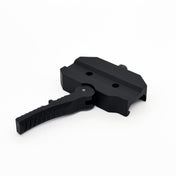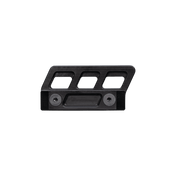

Search "best red dot for Glock MOS" and you'll get ranked lists. What you won't get is an answer to the question that actually stops the install: will this optic bolt to your slide?
MOS isn't a single standard. It's a family of slide cuts that changed across generations and frame sizes, and the adapter plate that shipped in your pistol case only fits some optics. Buy the wrong footprint and you own a red dot that sits in a drawer. So before anyone ranks anything, here's the fitment decision — which cut you have, which plate it takes, and where the install usually goes wrong.
Key Takeaways
- Standard-frame MOS pistols (G17, G19, G34, G45, G47) use adapter plate 02 for RMR-footprint optics; wide-frame MOS pistols use plate 06.
- The Glock 43X MOS and 48 MOS are different — they're cut for the Shield RMSc footprint and mount directly, with no plate at all.
- The RMR footprint has the widest plate and slide-cut support of any pistol pattern, which is why the $249.95 Mercury is built on it.
- Glock specs the plate-to-slide screws at 13.1 in-lb (1.5 Nm) with blue threadlocker — not "snug."
- The handgun red dot market was worth $1.8 billion in 2025 and is projected to reach $3.2 billion by 2034 (Dataintelo, 2025).
What Does "MOS" Actually Mean on a Glock Slide?
MOS stands for Modular Optic System, and it is a mounting interface — not an optic standard. The slide is machined with a shallow recess and four threaded holes. A steel adapter plate drops into that recess and translates it into one specific optic footprint. Your red dot bolts to the plate, and the plate bolts to the slide.
That two-stage design is why MOS is flexible and why it trips people up. The slide doesn't care what optic you buy. The plate does, absolutely.
Glock ships standard MOS pistols with one adapter plate in the case, and you can identify which cut you have from the item number sticker on the pistol case handle — a standard cut reads "MOS," while the newer K-series cut includes "MOSK" (Glock, 2026). Check the sticker before you order anything.
Handgun optics are no longer a niche. The handgun red dot reflector sight market was valued at $1.8 billion in 2025 and is projected to reach $3.2 billion by 2034, a 7.3% compound annual growth rate driven largely by law enforcement duty-pistol adoption (Dataintelo, 2025). That volume is exactly why the plate confusion costs people money — there are more optics chasing the market than there are slide cuts to hold them.
Which MOS Cut Does Your Glock Have?
There are four MOS cuts in circulation, and they are not interchangeable. Slide width is the first fork: 25.5 mm standard-frame slides and 27.5 mm wide-frame slides use different plate numbers for the same optic footprint (MountsPlus, 2026). The Slimline pistols skip plates entirely.
| MOS cut | Models | Plate for RMR footprint | Mounting screws |
|---|---|---|---|
| Standard MOS (25.5 mm slide) | G17, G19, G34 Gen5 MOS; G45, G47 | Plate 02 | Plate screws into slide |
| Wide MOS (27.5 mm slide) | G20, G21, G22, G23, G35, G40 Gen5 MOS | Plate 06 | Plate screws into slide |
| Slimline MOS | G43X MOS, G48 MOS | None — direct RMSc cut | M4, optic straight to slide |
| Slimline MOS-K | Newer slimline "MOSK" item numbers | None — takes RMSc or Holosun K | M3, optic straight to slide |
Sources: MountsPlus OEM plate chart for standard and wide-frame plate numbers; Glock for Slimline MOS and MOS-K screw specifications.
The Slimline MOS-K is the part almost nobody flags. It's the only Glock cut that accepts two different footprints with no adapter at all — RMSc or Holosun K — and it moved to M3 screws to do it. If you bought a slimline Glock recently and assumed it takes the same hardware as an older 43X MOS, it doesn't.
Which Adapter Plate Fits an RMR-Footprint Red Dot?
On a 25.5 mm standard-frame MOS slide, RMR-footprint optics run on plate 02. On a 27.5 mm wide-frame slide, the same footprint runs on plate 06 (MountsPlus, 2026). Plates 01 and 05 cover the Docter/Vortex Venom pattern; 04 and 08 cover DeltaPoint Pro and Shield RMS.
Worth knowing if you're shopping a Gen6: Glock renumbered. On the Gen6 Optic Ready System, plate 02 still carries the RMR family — Trijicon RMR, RCR, RMR HD, SRO, plus Holosun 507C, 407C and 508T — while 03 covers C-More and 04 covers the Vortex Defender, EOTech EFLX and DeltaPoint Pro (Glock, 2026).
Here's the practical takeaway buried in those charts. The RMR footprint is the only pattern that appears on both standard and wide-frame plate lists, on Gen5 and Gen6, and on nearly every aftermarket plate and milling service menu. It isn't the newest pattern. It's the one with the most doors open.
That's the reasoning behind building the Mercury reflex sight on the RMR footprint rather than something proprietary. A plate-and-footprint decision should not lock you to one pistol — the same optic should move to a PCC or a shotgun later. If you want the full pattern-by-pattern breakdown of how reflex sights differ from magnified optics, our red dot vs. prismatic scope comparison covers the optical side of that choice.
MOS Plate or Direct Slide Milling: Which Should You Pay For?
An OEM Glock MOS plate runs about $13. A direct optic cut runs $125 to $200, with refinishing pushing the total to $175 to $300, and lead times of one to four weeks in 2026 — though C&H Precision lists an optic-cut service from $125 with five working days or less after they receive the slide (Blue Haven Firearms, 2026).
So is milling worth ten times the price? Sometimes. Direct milling removes the plate interface, drops the optic lower on the slide (which is what lets suppressor-height irons co-witness properly), and eliminates one set of screws that can loosen. It's the better mechanical answer.
It's also permanent, single-footprint, and it means shipping your slide away. The plate costs $13, installs in ten minutes, and can be swapped when you change optics. For most shooters putting a first red dot on a MOS pistol, the plate is the right call — and if it turns out you hate the optic, you're out $13 and not a milling bill. We've argued the same logic about whether price actually reflects quality in optics: spend where the spend changes the outcome.
The Screws Are the Part That Actually Fails
Pistol optic screws have almost no mechanical reserve. You get three or four threads of contact with the tapped hole, and for steel M4 screws into steel base threads the recommended range is 16 to 23 inch-pounds — the author splits the difference at 20 (Optics Wire, March 2026). Glock specs the plate-to-slide screws at 13.1 in-lb (1.5 Nm) with blue threadlocker (MountsPlus, 2026).
Inch-pounds. Not foot-pounds, and not "until it feels tight."
There's a second, less-documented failure mode specific to MOS: screw length. Glock MOS owners report widely that the supplied screws run long, bottoming out in the optic body before the optic is actually clamped down. The rule of thumb from people who've dealt with it is to confirm at least 0.020" of clearance before the screw bottoms. The symptom is deceptive — the screw feels tight because it's jammed against the bottom of a blind hole, while the optic itself still has play. Then it shears.
Four habits prevent nearly all of this. Degrease the screws and the threaded holes with isopropyl alcohol. Use blue threadlocker, never red. Torque with an actual inch-pound driver. Re-check torque every 500 to 1,000 rounds.
Does that sound like overkill for a $13 plate? It's the difference between an optic that holds zero and one that walks. Most "my red dot lost zero" complaints are mounting problems wearing an optics costume.
So What Is the Best Red Dot for a Glock MOS?
We pulled the first page of results for this query before writing. Nine of the top results were affiliate ranking lists. Zero were optics manufacturers, and zero led with fitment. Every one of them ranked optics; not one answered which plate the reader needs — which is the step that actually blocks the purchase.
The honest answer is that "best" is downstream of "fits." Match the cut first:
| Standard or Wide MOS | G17, G19, G34, G45, G47, G20, G21. Buy an RMR-footprint optic and the matching plate — 02 for standard frames, 06 for wide. Widest support, easiest to re-home later. |
|---|---|
| Slimline MOS / MOS-K | G43X MOS, G48 MOS. You need an RMSc-footprint micro dot that mounts directly. An RMR-footprint sight is physically too large for these slides — no plate fixes that. |
The detail that matters most on a pistol is the battery tray: the Mercury loads from the top. On a bottom-loading sight, a dead battery means unmounting the optic and re-confirming zero. On a top-loader, you swap the cell and keep shooting. The Mercury is designed, assembled and tested in Texas — we wrote about why the Mercury is assembled in Texas if you want the manufacturing detail.
The tradeoffs, stated plainly: it's an open-emitter design, so it can collect lint or rain in the emitter channel the way every open reflex sight can. And it will not fit a 43X or 48 MOS. If that's your pistol, buy an RMSc-pattern optic instead — we'd rather tell you that than sell you a sight that doesn't mount.
The Bottom Line
Check your slide cut before you shop. Standard and wide-frame MOS pistols take an adapter plate, and RMR-footprint optics are the pattern with the most plates, mills and mounts behind them — which is why the Mercury is built on it at $249.95. Slimline 43X and 48 MOS owners need an RMSc optic that mounts direct. Then torque to spec with blue threadlocker, because the screws fail long before the glass does.
Frequently Asked Questions
Which Glock MOS plate fits an RMR footprint red dot?Plate 02 on 25.5 mm standard-frame slides (G17, G19, G34 Gen5 MOS, G45, G47) and plate 06 on 27.5 mm wide-frame slides (G20, G21, G22, G35). Gen6 pistols also use plate 02 for the RMR family (MountsPlus, 2026).
Does the Glock 43X MOS need an adapter plate?
No. The 43X MOS and 48 MOS are cut directly for the Shield RMSc footprint with M4 screws, so true RMSc-pattern optics bolt straight to the slide. Holosun K-series dots have matching screw spacing but different locating bosses, so those need a plate.
What torque should I use on Glock MOS optic screws?
Glock specs 13.1 in-lb (1.5 Nm) for plate-to-slide screws with blue threadlocker. Steel M4 optic screws into steel plate threads run 16 to 23 in-lb (Optics Wire, 2026). Use an inch-pound driver, not a hex key and guesswork.Is direct slide milling better than a MOS adapter plate?
Mechanically, yes — it sits lower and removes one screwed interface. Practically, it costs $125 to $200 plus one to four weeks without your slide, versus about $13 for a plate. Mill when you've settled on a footprint permanently, not for a first red dot.Will a Mercury reflex sight fit my Glock MOS?
Yes on standard and wide-frame MOS pistols, using plate 02 or plate 06 respectively — the Mercury is RMR-footprint. No on the 43X MOS and 48 MOS; those slimline slides need an RMSc-pattern micro dot, and no adapter plate changes that.Shop the Mercury

 https://cosmictactical.com