
Every optic in this story was carried by someone. A rifleman on a picket line in 1862. A doughboy in a French trench. A Marine on a night post in Vietnam. This Veterans Day, we want to look back at the glass they trusted, and at the people behind it.
The history of combat optics is short, about 160 years. But it tracks something bigger: how much we have asked of the men and women who serve, and how hard engineers have worked to give them a clearer view of what was in front of them.
1861: The sharpshooters of the Civil War

Winslow Homer, The Army of the Potomac: A Sharp-Shooter on Picket Duty (1862). Public domain, via Wikimedia Commons.
The first American soldiers to fight with telescopic sights were Civil War sharpshooters. In 1861, Colonel Hiram Berdan began raising elite Union sharpshooter regiments, and every volunteer had to pass a marksmanship test to join. The 1st Massachusetts Sharpshooters, organized the same year, carried heavy target rifles with scopes ranging from about 4x to 20x.
On the Confederate side, some sharpshooters carried the English-made Whitworth rifle, often fitted with a Davidson telescope patented in 1862. These scopes were long brass tubes, fragile and slow to use. But they changed what one patient, skilled soldier could do from a distance, and they started a story that is still being written.
1917: A prism goes to war

American First World War Official Exchange Collection (Q103350), via Wikimedia Commons.
When the United States entered World War I, its standard rifle scope was already a prism design. The Warner & Swasey Telescopic Musket Sight, Model of 1913 mounted on the M1903 Springfield. It used prisms to fold the light path, giving a wide field of view at 5.2x.
It was not an easy sight to love. It mounted off to the side, forcing an awkward cheek weld, and the rubber eyecup was hard on the face under recoil. Still, about 4,000 were procured by the Armistice, with an allowance of 96 per division. They were the only U.S. sniper rifles fielded in real numbers during the war, carried by doughboys who made them work in the mud of France.
More than a century later, the core idea behind that sight, a compact prism that packs real magnification into a short body, is the same idea inside today's prism scopes.
1943: World War II and Korea

M1903A4 scopes, via Wikimedia Commons.
In 1943, the Army ordered 20,000 sniper rifles from Remington. They were M1903A3 Springfields fitted with a Redfield mount and a Weaver 330 scope, designated the M73B1, and the rifle became the M1903A4. It was a commercial hunting scope pressed into service, and soldiers carried it from Normandy to the Pacific.
By 1944, the Army was also developing scoped versions of the M1 Garand, the M1C and M1D. Only a few M1Cs are believed to have reached combat before the war ended. In Korea, the M1C and Marine rifles with Unertl scopes did most of the work, and the M1D went on to serve into Vietnam.
1960s: Vietnam and the Starlight scope

U.S. Army night sniper scope, 1961, via Wikimedia Commons.
In World War II, seeing at night meant an active infrared Sniperscope: a heavy battery pack and an IR lamp that any enemy with his own IR scope could see like a lighthouse. Vietnam changed that.
The AN/PVS-2 Starlight scope was a passive image intensifier. It needed no lamp at all. It took the faint light of the moon and stars and amplified it into a usable picture. At nearly 6 pounds it was too heavy for many patrols, so soldiers and Marines mounted it on rifles at patrol bases and night posts, where one scope could watch over a whole stretch of the line.
For the men standing those night watches, it was a small piece of reassurance in a war fought largely in the dark.
1995 to today: A dot and a 4x prism on every rifle

U.S. Marine M16A4 with a 4x prism optic, via Wikimedia Commons.
For most of the 20th century, scopes belonged to snipers. The everyday rifleman fought with iron sights. That changed in the 1990s.
In 1995, U.S. Special Operations Command selected a 4x32 prism scope, Trijicon's TA01 ACOG, as the official optic for its M4 carbines. In 2000, the Aimpoint CompM2 red dot entered U.S. service as the M68 Close Combat Optic. Between 2004 and 2005, the Marine Corps adopted a 4x prism as its Rifle Combat Optic, adding a fiber-optic pipe to light the reticle in daylight.
Through Iraq and Afghanistan, a red dot or a fixed 4x prism became standard issue on the service rifle. A generation of soldiers and Marines learned to fight both eyes open, and came home knowing exactly what a good optic is worth.
The glass changes. The people don't.
Brass tubes became prisms. Prisms became red dots and night vision. What never changed is the person behind the sight: someone who stood a watch, carried the weight, and came home carrying more than gear.
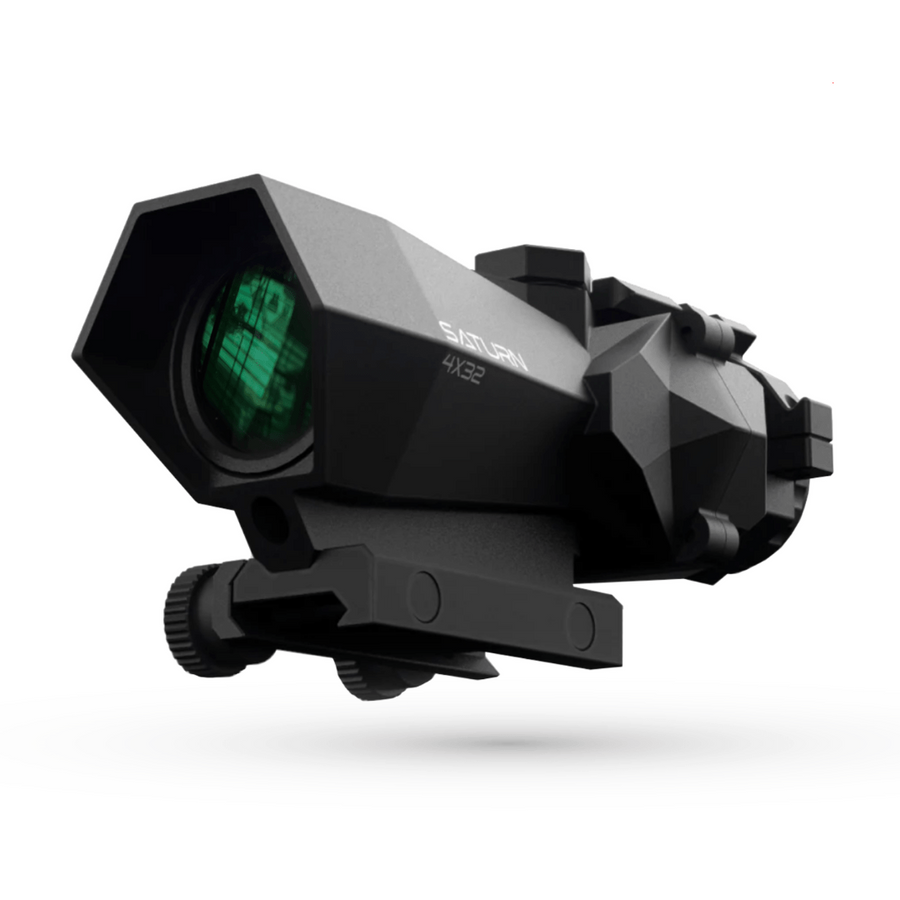
We build optics, so we think about this history a lot. Our SATURN™ 4x32 is a fixed 4x prism, the same idea that went to France in 1917 and to Iraq in the 2000s, built for today's shooters. Our MERCURY™ is a 1x reflex sight for speed up close. Many of the people who run them learned what a good optic is worth in uniform.
To every veteran: thank you. For your service, and for everything you carried so the rest of us didn't have to.
Sources
- Readex: Telescopic rifle sights in the American Civil War
- American Rifleman: Doughboy Sniper Rifles of World War I
- Captain Stevens: American sniper rifles and scopes
- Sandboxx: The history of US military night vision
- The Firearm Blog: Vietnam-era AN/PVS-2 Starlight scope
- We Are The Mighty: ACOG history
- Wikipedia: Aimpoint CompM2 (M68 CCO)

 https://cosmictactical.com