
Key Takeaways
- A "duty red dot" earns the name through four things: it holds zero under recoil, it survives water and dust (IP-rated), it takes impacts without failing, and its battery is always ready when you grab the gun.
- None of those is "size." Duty toughness is engineered, not bulky — the most combat-proven duty pistol optic on earth, the Trijicon RMR, is a compact open-emitter sight.
- The takeaway: you can get duty-grade durability without paying premium-tier prices.
Spend ten minutes in any optics forum and you'll see the same divide: there are "duty" red dots — the ones people trust to take a beating and hold zero — and then there's everything else, quietly labeled "range toys." Trijicon and Aimpoint sit on one side. A lot of budget glass sits on the other.
Here's what that conversation usually gets wrong: people treat "duty-grade" like it's a price bracket or a size class. It's neither. Duty capability is a set of measurable durability traits, and a sight either has them or it doesn't — regardless of what it costs or how big it is.
This guide breaks down what actually separates a duty red dot from an everyday one, where the line really sits, and how to read past the marketing so you buy once.
What Makes a Red Dot "Duty-Grade"?
A duty red dot is one built to keep working when everything goes wrong: dropped on concrete, soaked in a downpour, baked in a patrol car, and fired hard without ever being re-zeroed. The label comes down to four durability pillars — not size, weight, or brand prestige.
One honest caveat up front: there is no official governing body that certifies a red dot as "duty-grade." No agency stamps it. It's an industry convention built from real, testable attributes. So when a maker says "duty," the right response is "prove it" — and the proof lives in these four areas.
1. Zero retention under recoil
This is the one that matters most. A duty optic keeps its point of impact aligned with the bore after hundreds or thousands of rounds — and after it gets knocked around. Reviewers test this by firing long strings without re-zeroing and measuring how far impact drifts; a sight that wanders is disqualifying no matter how good it looks. If a red dot can't hold zero, nothing else about it counts.
2. Ingress protection — water and dust
Duty gear gets wet and dirty. The industry measures this with the IP rating system defined by the International Electrotechnical Commission (standard IEC 60529). The first digit covers dust; a 6 means fully dust-tight. The second covers water: IP67 means submersible to 1 meter for 30 minutes, and IP68 means dust-tight plus continuous submersion beyond 1 meter, to a depth and time the manufacturer specifies. (Per the IEC's published IP code.) One thing makers rarely mention: IP tests use fresh water, and seals degrade with age — so treat any rating as a when-new benchmark, not a lifetime guarantee.
3. Impact and environmental survival
Beyond water, duty optics are expected to shrug off drops and temperature swings. Many makers reference MIL-STD-810, the U.S. military's environmental test methodology covering shock, vibration, thermal extremes, humidity, and salt fog. A common transit-drop convention cited for optics is 1.8 meters (6 feet) onto concrete. Be careful here, though: MIL-STD-810 is a library of test methods, not a pass/fail certification. "Tested to MIL-STD-810" only means something if the maker discloses which methods and parameters they ran.
4. Battery reliability and always-on readiness
A duty optic is useless if the dot is dark when you need it. Premium duty sights publish multi-year runtimes — Aimpoint's Duty RDS lists 30,000 hours, and the Trijicon RMR runs roughly four years on a CR2032. Just as important is motion activation ("shake awake"): the sight sleeps to conserve power and wakes instantly when the gun moves, so it's always ready on the nightstand or in the holster.
Duty-Grade Doesn't Mean Bulky
Here's the myth worth killing: that a tough optic has to be a big optic. It doesn't. Look at the single most battle-proven duty pistol red dot in existence — the Trijicon RMR, the sight U.S. Special Operations Command selected for its handguns in 2018. It's a compact, roughly 1.2-ounce open-emitter sight. Small. Light. And the standard everything else is measured against.
That tells you everything about where toughness comes from. It's not bulk — it's the housing alloy, the sealing, the lens geometry, and the quality of the internals. A well-built compact sight can take everything a duty mission throws at it; a poorly built large one can't. Size is a design choice, not a durability spec.
So when you're shopping, stop asking "is this big and heavy enough to be serious?" and start asking "does it hold zero, is it sealed, will it survive a drop, and will the battery be alive when I need it?" Those questions sort the duty optics from the range toys far better than a scale ever will.
The "Duty vs. Everyday" Divide Is Real — But It's Not About Price
The perception gap is genuine. The premium-duty tier — Aimpoint and Trijicon — has spent decades building a documented track record through published torture tests and military adoption, and reviewers still call them the standard others are held against. When your life depends on the gear, that track record is worth paying for, and we won't pretend otherwise.
But the idea that duty capability is reserved for the $450-and-up tier doesn't survive contact with the data. In the 2025 POLICE Magazine Pistol Optics Survey, 77% of officers said their agency now allows duty handgun optics, and 76% are actually running one. The most-used optic brand on duty wasn't Trijicon or Aimpoint — it was Holosun, at 39%, a mid-priced, open-emitter-heavy brand. Off duty, Holosun's share jumped to 52%.
of law enforcement officers run Holosun on their duty weapon — the #1 brand, ahead of Trijicon and Aimpoint.
Source: POLICE Magazine Pistol Optics Survey, 2025
That's the real story: the duty tier is defined by durability, and durability is now being engineered into optics that don't carry a premium-tier badge. The question isn't "expensive or cheap." It's "tested or not."
If you want the longer version of how price and quality actually relate in optics, we dug into it in our breakdown of whether price reflects quality in riflescopes — the short answer is that the curve flattens out fast above a certain point.
Does an Open Emitter Disqualify a Duty Red Dot?
Short answer: no — but it's a fair question, and it deserves an honest answer.
An open-emitter sight has an exposed LED, which means rain, mud, snow, or lint can theoretically settle on the diode and blank the dot. An enclosed-emitter sight seals the LED inside a tube, and credible sources — including Primary Arms — note that enclosed designs hold an edge in the muddiest, harshest conditions. If you're crawling through a swamp, an enclosed emitter is the more forgiving tool. We won't tell you open and enclosed are identical, because they're not.
Here's the counterweight, and it's decisive: the most combat-proven duty pistol optic in the world, the Trijicon RMR, is open-emitter. So is the Holosun that's leading law enforcement adoption. Open architecture is demonstrably not disqualifying for duty — what matters is how well that open design is built and sealed against the environment. The emitter style is a trade-off to understand, not a verdict. New to these terms? Our complete guide to reflex sights walks through open versus enclosed in plain language.
Duty Criteria Head-to-Head: Trijicon RMR vs. the Mercury
Instead of comparing brand names, compare the traits that actually define duty capability. Here's the gold-standard Trijicon RMR Type 2 next to the Cosmic Tactical Mercury, using published specs only.
| Duty criterion | Trijicon RMR Type 2 | Cosmic Tactical Mercury |
|---|---|---|
| Price (street) | ~$450–$550 | $249.95 |
| Emitter type | Open | Open |
| Footprint | RMR | RMR-compatible |
| Weight | ~1.2 oz | 1.52 oz |
| Water resistance | Submersible to 20 m | IP68 — dust-tight, submersible 3 m / 30 min |
| Battery | CR2032, ~4 years | CR2032, up to 3 years |
| Power management | Always-on, auto-adjust brightness | Motion activation (shake-awake) + auto-sleep |
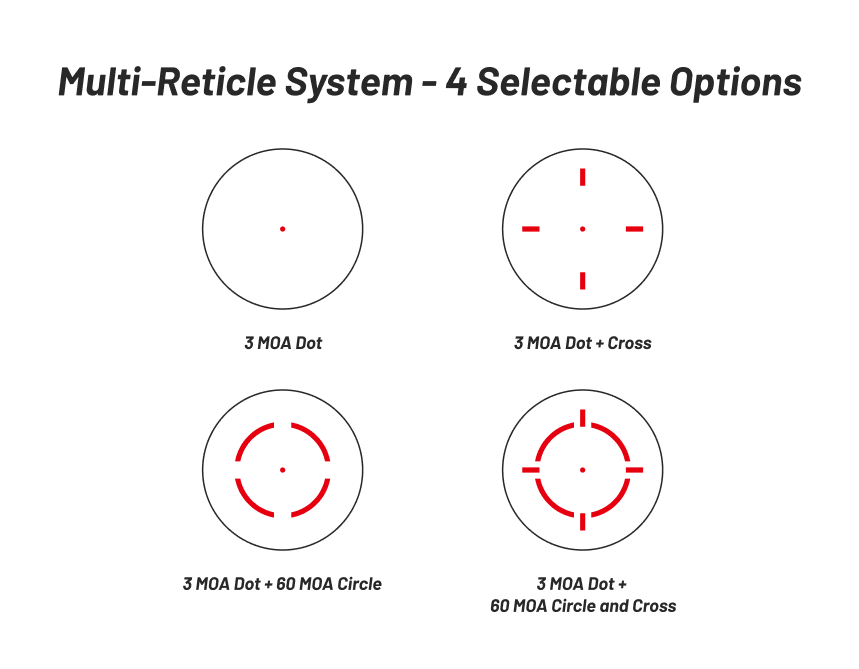
| Reticle | Single dot (per model) | 4 selectable reticles, red or green |
| Origin | Made in USA | Designed, assembled & tested in USA (Texas) |
Read it honestly and two things stand out. The RMR has the deeper waterproof spec (20 m vs. 3 m) and a decades-long proven track record — that's real, and it's part of what your money buys. But on the core duty criteria — open-emitter RMR footprint, comparable weight, sealed and submersible, multi-year battery, made in the USA — the Mercury covers the same ground for roughly half the price, and adds motion activation and four selectable reticles on top.
Where the Mercury Lands
We'll be straight about this, because overpromising is how brands lose trust: the Mercury does not have a military contract or a published independent torture-test record. The RMR and Aimpoint earned their reputations over years of documented hard use, and that pedigree is theirs. We're not claiming to be "battle-proven" — we haven't been to that war.
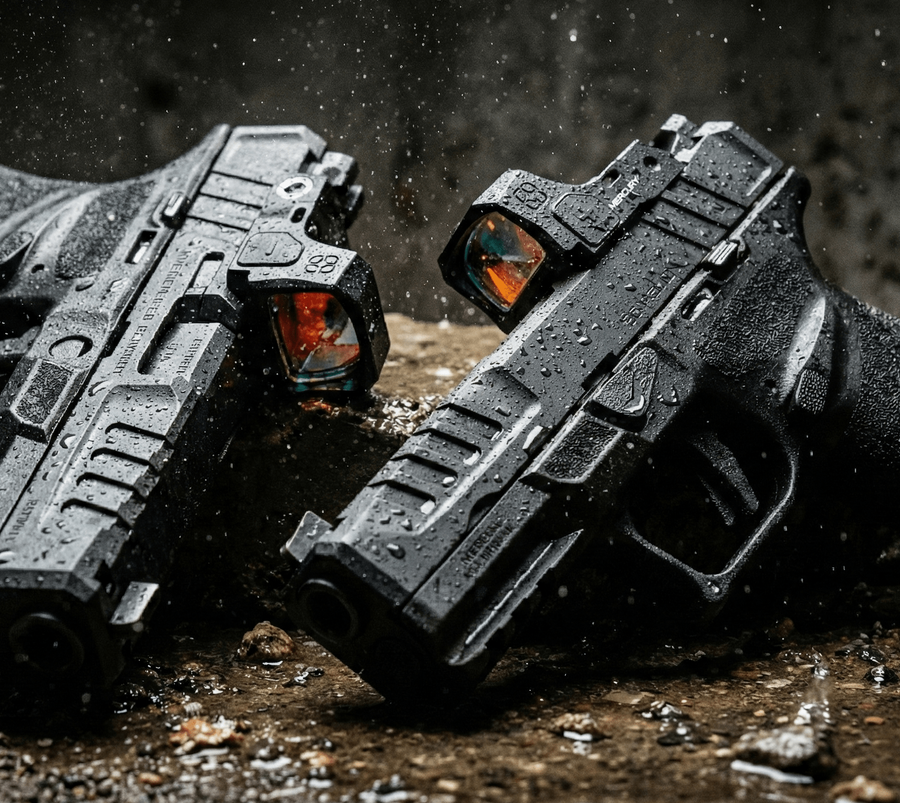
What we can stand behind are the specs and the build. The Mercury is an open-emitter sight on the proven RMR footprint, rated IP68 for dust and water, running a top-loading CR2032 with up to three years of life and motion activation so the dot's always ready. It's designed, assembled, and tested in Texas — and that "made in USA" story, at this price, is genuinely hard to find. It's engineered to duty-grade durability principles, in a compact package, without the premium-tier price tag.
If you want the gold standard with the deepest track record and budget isn't the constraint, buy the RMR — it's the standard for a reason. If you want duty-grade durability traits in a compact, made-in-USA optic and you'd rather not spend $450, the Mercury was built for exactly that shooter.
Frequently Asked Questions
What makes a red dot "duty-grade"?
Four measurable traits: it holds zero under recoil, it's sealed against water and dust (typically IP67 or IP68), it survives drops and temperature extremes, and it has a reliable multi-year battery with motion activation so it's always ready. There's no official certification for "duty-grade" — it's an industry convention, so look for published specs and testing rather than the label alone.
Are budget red dots reliable enough for duty?
It depends on the specific optic's build and testing, not its price. Some mid-priced optics are durable enough that they lead law enforcement adoption — Holosun was the most-used on-duty brand in the 2025 POLICE Magazine survey at 39%. Bargain-bin optics with no IP rating or zero-retention data usually aren't built for it. Judge the specs, not the sticker.
Is an open-emitter red dot okay for a duty pistol?
Yes. The most combat-proven duty pistol optic in the world, the Trijicon RMR, is open-emitter, as is the Holosun that leads law enforcement use. Enclosed emitters hold an edge in extreme mud and debris, but open emitters are widely trusted for duty. What matters is how well the optic is built and sealed.
Does a red dot have to be big or heavy to be tough?
No. Toughness comes from the housing material, sealing, and internal construction — not size. The RMR is a compact, roughly 1.2-ounce sight and it's the duty benchmark. A well-engineered compact optic can be just as rugged as a larger one.
What IP rating should a duty red dot have?
Look for IP67 or IP68. IP67 means dust-tight and submersible to 1 meter for 30 minutes; IP68 means dust-tight and submersible beyond 1 meter, to a depth the manufacturer specifies. The Cosmic Tactical Mercury is rated IP68 (submersible to 3 meters for 30 minutes). Remember IP tests use fresh water, so treat the rating as a when-new benchmark.
Duty-grade durability. Compact footprint. $249.95.
The Mercury brings the traits that define a duty red dot — without the premium-tier price.

 https://cosmictactical.com