
Buy a Ruger 10/22 and the optic recommendation arrives about four seconds later: a 2-7x32 rimfire scope. It's the default in every combo package, every forum reply, every ranking list. Nobody asks whether it's the right answer for what you actually shoot.
Here's the question that decides it, and it isn't magnification. Is your aiming point smaller than your target? Run that one calculation and the red-dot-or-scope argument resolves itself in about thirty seconds — differently for a guy shooting steel at 40 yards than for a guy head-shooting squirrels at 60.
- A 3 MOA dot covers 1.5 inches at 50 yards — roughly the whole head of a squirrel. That single number decides red dot versus magnified optic.
- For plinking, steel and reactive targets inside 50 yards, a reflex sight is the better fit. For precision small game or anything past 50, it isn't.
- .22 LR falls off a cliff past its zero — a 40-grain load drops between 2.5 and 7.6 inches at 100 yards depending on the load (Ammunition To Go, 2026). A dot gives you nothing to hold over with.
- Don't copy AR mounting logic. A factory 10/22 stock sits your cheeklower than an AR stock, so a tall co-witness riser puts the dot above where your head naturally lands.
- The 10/22 receiver is factory-drilled for a Weaver or Picatinny base — and it's aluminum, so torque matters more than it does on a steel receiver.
What Are You Actually Shooting With Your 10/22?
Americans buy roughly 1.5 billion rounds of .22 LR a year, and the overwhelming majority of it goes downrange at cans, steel and paper inside 50 yards. The Ruger 10/22 — more than seven million built as of 2015, in continuous production since 1964 (Ruger 10/22 production record) — is the rifle doing most of that shooting.
That matters because "best optic" is meaningless without a distance and a target size. The same rifle serves four jobs that want four different answers:
Plinking and steel. Reactive targets, 15 to 50 yards, often on the move. You want speed and both eyes open. Small game. Squirrels and rabbits, 25 to 60 yards, on a target the size of a golf ball (Ammunition To Go). You want a fine aiming point. Rimfire competition. NRL22 stages run out to 200 yards (Warne). You want magnification and a holdover reticle. Trainer work. Cheap trigger time that mimics your centerfire rifle. You want the same sight picture you run on the big gun.
Jobs one and four point at a red dot. Jobs two and three point at glass. Most people own the rifle for job one and get sold the optic for job three.
Does a 3 MOA Dot Cover Your Target?
One minute of angle spans about one inch at 100 yards, so a 3 MOA dot covers roughly 0.8 inches at 25 yards, 1.5 inches at 50, and 3.1 inches at 100. A squirrel's head — which is also, functionally, its vital zone — is about the size of a golf ball, near 1.7 inches (Ammunition To Go).
Put those two numbers next to each other. At 50 yards your dot almost exactly blots out the thing you're trying to hit.
This is the fork in the road, and we have yet to see a single 10/22 ranking list run the number. Covering the target isn't automatically disqualifying — on an eight-inch steel plate at 50 yards, a 1.5-inch dot is a fifth of the plate and you'll hit it all day. On a squirrel's head at the same distance, the dot is the squirrel's head. You're aiming at something you can't see.
So the honest rule isn't "dots are for close range." It's: your aiming point has to be meaningfully smaller than your target. Big reactive targets forgive a big dot. Small precise targets don't, at any distance. If you want the full optical breakdown of how projected dots and etched reticles differ, our red dot vs. prismatic scope comparison covers the mechanics.
Red Dot or Prism: What Each One Actually Gives You
A reflex sight and a prism scope solve different problems, and the spec sheets bury that under feature lists. Here's the split that matters on a 5-pound rimfire carbine:
| Factor | Reflex sight (1x) | Prism scope (fixed 4x) |
|---|---|---|
| Aiming point at 50 yd | 1.5 in (3 MOA dot) | Etched chevron tip — far finer |
| Eye relief | Unlimited; head position forgiving | Fixed; you must build a consistent cheek weld |
| Both eyes open | Yes, natural | Possible but not the point |
| Holdover past zero | None — the dot is your only reference | Reticle hashes give you references |
| Weight on a 5 lb rifle | Minimal | Noticeable; changes the balance |
| Best window | Inside 50 yd, larger targets | 50–100 yd, precise targets |
| Astigmatism | Dot may smear or starburst | Etched reticle stays crisp |
One thing worth saying out loud, because the ranking lists never do: don't buy a red dot on a speed claim. KR Training and the Texas A&M Huffines Institute collected data on 118 shooters, novice through USPSA Grand Master, ages 18 to 76, comparing slide-mounted red dots against iron sights and lasers. Did the red dot shooters shoot better? "No" (KR Training). Many shooters struggled to find the dot on initial presentation.
That study was pistols, not rifles, and a rifle's stable cheek weld makes finding the dot far easier. But it punctures the marketing premise. Buy a reflex sight because the target is big and the distance is short — not because a blog told you it's faster.
The .22 LR Trajectory Problem Past 50 Yards
.22 LR is a slow, blunt, subsonic-to-barely-supersonic round, and its trajectory reflects that. A 40-grain standard-velocity load leaves the muzzle at roughly 1,070 to 1,200 fps, high velocity at 1,235 to 1,280, and depending on the load it lands somewhere between 2.5 and 7.6 inches low at 100 yards (Ammunition To Go, 2026). At 200 yards a 40-grain bullet sinks about 33 inches.
An etched reticle fixes the reference problem. You get hash marks below center that you can zero your own holds to. Worth stating plainly, though: the Saturn 4x32's BDC is calibrated for .223/5.56 or .308/7.62, not .22 LR. The hashes won't line up with rimfire out of the box. What you get is a fine chevron tip, 4x magnification and a fixed set of reference points you can map to your own load — which is a real advantage over a dot, but it's work. Our guide to zeroing a prismatic scope walks through that process.
There's a second reason to think about glass here. Rimfire-specific scopes are built parallax-free at about 50 yards, while centerfire scopes are set for 100 or 150 (Warne). A 4x prism built for centerfire distances is not a purpose-built rimfire optic, and we're not going to pretend otherwise.
Mount Height Is Where 10/22 Optic Builds Go Wrong
The 10/22 receiver comes factory-drilled for a scope base that takes either a Weaver or Picatinny rail, and the factory base that ships with the rifle is serviceable but basic (Warne; EGW). Aftermarket rails run 15 to 20 inch-pounds on the mounting screws.
Note the receiver is aluminum, not steel. Warne's guidance is blunt about it: "it is very important never to exceed Ruger's torque specifications." Strip those threads and you're into a helicoil, not a trip to the range.
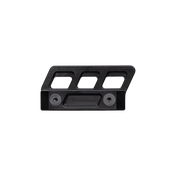
The mistake we see most often isn't torque, though. It's height, and it comes from people importing AR habits. On an AR, a red dot sits in a 1.4-inch mount so the optic lines up with a stock that puts your cheek high. A factory 10/22 stock does the opposite — it "generally places your cheek lower than an AR-style stock, so a tall co-witness riser can put the aiming point higher than necessary" (MountsPlus).
Buy the AR-height riser out of habit and you end up craning your neck to find the dot on every shot. Mount a compact sight low and close to the receiver instead, unless your 10/22 wears a chassis, raised comb or adjustable cheek piece — in which case go taller. The goal is matching optic height to where your head already lands, not chasing the lowest number.
So What Should You Put on Your Ruger 10/22?
We pulled the first page of results for this query before writing. Seven of the top nine were affiliate ranking lists. Zero were optics manufacturers. Every one of them ranked products; not one ran the subtension math that determines whether a dot can even resolve the target you're shooting at. The default recommendation across them was a 2-7x32 variable — a scope that weighs about 13 ounces before rings on a rifle that weighs five pounds.
Match the optic to the job instead:
Buy a reflex sight
Plinking, steel, cans and fast reactive targets inside 50 yards. Big targets forgive a 3 MOA dot, and you keep both eyes open, unlimited eye relief and almost no added weight on a light carbine.
Buy magnified glass
Head-shooting small game, punching paper, or anything past 50 yards. You need an aiming point smaller than the target and reference marks to hold over with. A dot gives you neither.
For the reflex column, the Mercury is our answer at $249.95. Four selectable reticle configurations, nine brightness levels including a night-vision setting, IP68 waterproofing, and motion activation that wakes on movement and sleeps after five minutes idle — which matters on a rifle you grab for an hour and put back. Battery life runs up to three years on a top-loading CR2032, so a dead cell never costs you your zero. It's designed, assembled and tested in Texas; we wrote up why the Mercury is assembled in Texas if you want the manufacturing detail.
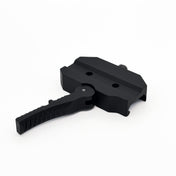
The tradeoffs, stated straight. The 3 MOA dot covers 1.5 inches at 50 yards, so it is the wrong tool for squirrel head shots — that limitation is physics, not a brand problem, and it applies to every 3 MOA sight on the market. It's an open-emitter design, so the emitter channel can collect lint or rain. And the RMR footprint means you'll want a rail or mount that takes it rather than a bare dovetail.
For the magnified column, the Saturn is the honest secondary answer rather than the obvious one. It earns its place in one specific setup: if you run an AR and use the 10/22 as a cheap trainer, a Saturn on a Titan quick-release mount moves between both rifles and gives you the same sight picture on each — which is the entire point of rimfire trainer work. What it is not is a purpose-built rimfire scope. It's heavier than a 2-7x32, its BDC is centerfire-calibrated, and it's parallax-set for centerfire distance. If your 10/22 never leaves the squirrel woods, a dedicated rimfire scope is the better buy, and we'd rather say that than sell you the wrong tool. The case for fixed 4x32 magnification is strongest on a centerfire rifle.
The Bottom Line
Stop asking which optic is best and ask whether your aiming point is smaller than your target. A 3 MOA dot spans 1.5 inches at 50 yards — fine on steel, far too coarse for a squirrel's head. If you plink inside 50 yards, a reflex sight like the $249.95 Mercury is the right call and the 2-7x default is an upsell. If you shoot precise targets or reach past 50, buy glass with a fine reticle and holdover marks. Then mount it low, because your 10/22 stock isn't an AR stock.
Frequently Asked Questions
Is a red dot good enough for a Ruger 10/22?
For plinking, steel and targets inside 50 yards, yes — it's arguably better than a scope. A 3 MOA dot covers 1.5 inches at 50 yards, which is a fraction of an 8-inch plate. For squirrel head shots on a golf-ball-sized target, it's too coarse.
What magnification do I need for a 10/22 at 100 yards?
Enough to resolve the target plus a reticle with holdover references. A 40-grain .22 LR drops between 2.5 and 7.6 inches at 100 yards from a 50-yard zero (Ammunition To Go, 2026), and a plain dot gives you no way to measure that hold.
Does the Ruger 10/22 need a rail to mount a red dot?
Yes, in practice. The receiver is factory-drilled for a scope base that takes a Weaver or Picatinny rail (Warne). The receiver is aluminum, so stay inside Ruger's torque spec — aftermarket rails typically call for 15 to 20 inch-pounds.
Why do rimfire scopes have a 50-yard parallax setting?
Because that's where rimfire rifles get shot. Rimfire scopes are built parallax-free at roughly 50 yards while centerfire scopes are set for 100 or 150 (Warne). A centerfire scope still works, but you may need to drop magnification up close.
Should I use an AR-height riser on my 10/22?
Usually not. A factory 10/22 stock puts your cheek lower than an AR stock, so a tall co-witness riser sits the dot above your natural head position (MountsPlus). Mount low and close to the receiver unless you're running a chassis or adjustable comb.
Four reticles, nine brightness levels, IP68, three-year battery — and $249.95.
Shop the Mercury
 https://cosmictactical.com