
Updated: May 2026 · Reading time: ~9 min · By: Cosmic Tactical Optics Team
TL;DR: The Trijicon ACOG TA31 ($1,199+) earns its price with tritium night illumination and forged 7075-T6 housing. The Cosmic Tactical Saturn 4x32 ($299.95) delivers the same fixed 4x, etched BDC reticle, fiber-optic illumination, and nitrogen-purged housing for ~75% less. It's the right pick for range, hunting, competition, and home defense.
Why Compare the Saturn 4x32 to the Trijicon ACOG TA31?
If you're shopping for a fixed 4x32 prism scope in 2026, two names keep coming up: the Trijicon ACOG TA31 and the modern alternatives built on the same concept. The ACOG pioneered the format that militaries worldwide adopted — a compact, battery-free prism scope with an etched reticle and caliber-specific BDC. It set the standard.
Setting the standard twenty years ago doesn't mean the standard hasn't evolved. Modern manufacturing, better coatings, and direct-to-consumer pricing have changed the math. The Trijicon ACOG TA31 retails for $1,199–$1,815, while the Cosmic Tactical Saturn 4x32 retails for $299.95 (a ~$900 difference for the same fixed 4x32 prism platform). The price gap reflects tritium, forged 7075-T6 housing, and military pedigree, not core capability.
Saturn vs ACOG: Full Specs Comparison
Across 14 measured specifications, the Saturn 4x32 and ACOG TA31 share identical magnification (4x), objective (32mm), reticle technology (etched), illumination concept (fiber optic), and warranty class (limited lifetime). The ACOG leads in waterproof depth (100m vs 10m), turret precision (1/3 MOA vs 1/2 MOA), and field of view (36.8 ft vs 31.5 ft at 100 yards).
| Specification | Cosmic Tactical Saturn 4x32 | Trijicon ACOG TA31 |
|---|---|---|
| Magnification | 4x (fixed) | 4x (fixed) |
| Objective Lens | 32mm | 32mm |
| Eye Relief | 2.05 in (52mm) | 1.5 in (38mm) |
| FOV at 100 yds | 31.5 ft | 36.8 ft |
| Reticle | Etched chevron with BDC | Etched (6 types available) |
| BDC Calibration | .223/5.56 or .308/7.62 | .223/5.56 (M855 or M193) |
| Illumination | Fiber optic (no batteries) | Fiber optic + tritium (no batteries) |
| Housing | Aircraft-grade aluminum | Forged 7075-T6 aluminum |
| Waterproof | 33 ft (10m) | 328 ft (100m) |
| Fog-proof | Yes (nitrogen-purged) | Yes (nitrogen-filled) |
| Adjustment | 1/2 MOA per click | 1/3 MOA per click |
| Weight (with mount) | ~16.5 oz | 15.1 oz |
| Length | 5.71 in | 5.8 in |
| Colors | Black, FDE (more colors coming soon) | Black, FDE, OD Green, Sniper Gray (Cerakote) |
| Warranty | Limited Lifetime + 60-day money back guarantee | Limited Lifetime |
| Price | $299.95 | $1,199 - $1,815 |
Which Has Better Build Quality and Durability?
The ACOG wins on raw build credentials. Its forged 7075-T6 aluminum housing is the same alloy used in aircraft structural components, and the TA31 has survived IED blasts, vehicle rollovers, and helicopter drops onto concrete across two decades of Iraq and Afghanistan deployments. It's rated waterproof to 100 meters versus the Saturn's 10 meters (a 10x depth advantage).
The Saturn uses aircraft-grade aluminum with a matte anodized finish and is third-party lab certified for shock, water, dust, and temperature extremes — independent verification rather than internal marketing claims. It holds zero through sustained recoil from .223/5.56 and .308/7.62 platforms.
For civilian use — hunting, competition, home defense, range training — the Saturn's build is more than adequate. For Marines crawling through Helmand Province mud, the ACOG's pedigree matters. Each tier of certification serves a different mission profile.
Which Has Better Optical Clarity and Field of View?
The ACOG TA31 has earned consistent praise for optical clarity that rivals European optics costing two to three times as much. Its multi-coated lenses produce bright, sharp images with minimal edge distortion. The Saturn's multi-coated lenses delivered what GUNSweek called "astonishing optical quality" and earned a 3.5 out of 5 clarity rating from The Truth About Guns; strong for its price class, but not matching premium glass in low-light edge sharpness.
Field of view: The ACOG wins with 36.8 ft at 100 yards versus the Saturn's 31.5 ft (17% wider), which matters in dynamic shooting where targets move laterally.
Eye relief: The Saturn wins with 2.05 inches (52mm) versus the ACOG's 1.5 inches (38mm), a 37% relief advantage. That's meaningful on heavier-recoiling platforms and forgives sloppy shooting positions.
How Do the Reticle Systems Compare?
Both scopes use etched reticles — the defining feature that makes prism scopes ideal for shooters with astigmatism. An etched reticle is physically engraved into the glass rather than projected as light, so it stays crisp regardless of eye conditions. The Saturn offers BDC variants for either .223/5.56 or .308/7.62 at $299.95; the equivalent .308-calibrated ACOG starts at $1,400+, a ~4.7x cost advantage for .308 builds.
The ACOG TA31 offers six reticle configurations (chevron, crosshair, donut, horseshoe/dot, triangle variants) with BDC marks calibrated for 5.56 NATO out to 800 meters and 1/3 MOA adjustments (finer than the Saturn's 1/2 MOA). The Saturn features an etched chevron reticle with BDC hash marks calibrated for either .223/5.56 (62-grain) or .308/7.62.
The Saturn's .308/7.62 BDC option is a real differentiator — an ACOG calibrated for .308 costs $1,400+, which makes the price gap on AR-10 builds even more dramatic than on a standard AR-15.
How Does the ACOG's Tritium Illumination Actually Work?
The ACOG TA31 uses a dual illumination system. Fiber-optic strips collect ambient light during the day; that's the same concept as the Saturn's daytime illumination. Tritium inserts then provide a faint glow in complete darkness. Tritium is a radioactive hydrogen isotope with a 12.3-year half-life, allowing the reticle to glow 24/7 for roughly a decade before brightness drops to 50% and refurbishment is needed. Trijicon refurbishment runs $200–$300 plus shipping.
This enables the Bindon Aiming Concept (BAC): shooting with both eyes open, where the illuminated reticle in the dominant eye superimposes on the target scene from the non-dominant eye. In low-light building clearance or dawn/dusk engagements, this is a genuine tactical advantage.
The Saturn uses fiber-optic illumination only. In daylight and twilight, the fiber-optic strip gathers ambient light and illuminates the etched reticle identically to the ACOG. In total darkness, the Saturn's reticle reads as a black etched crosshair against whatever ambient light exists. It doesn't glow independently. The fiber-optic system doesn't degrade, so day 5,000 performs identically to day one.
Do You Actually Need Tritium for Your Shooting?
Tritium only matters in conditions with zero ambient light. Most civilian shooters won't encounter those conditions. Here's the role-by-role breakdown:
- Active military, SWAT, or night operations without NVGs
- Yes. Tritium's self-luminous capability in total darkness has no alternative at this price, and the ACOG is the right call.
- Home defense
- Maybe. Most home defense scenarios involve some ambient light (streetlights, hallway lights). If you're running a weapon light — which you should be for target identification — the fiber-optic system picks up that light and illuminates the reticle.
- Hunting, range, and competition
- No. You're shooting in ambient light where fiber-optic illumination performs identically to the ACOG's daytime system. The Saturn does the job.
- Long-term ownership math
- After 12 years, ACOG tritium brightness drops to 50% and refurbishment costs $200–$300 plus shipping. The Saturn's fiber-optic system never needs servicing.
Does the ACOG's Military Heritage Justify the Price?
The U.S. Marine Corps adopted the Trijicon ACOG TA31RCO as standard issue in 2004–2005, fielding 115,000 units across every rifle and carbine. SOCOM purchased 12,000 units as early as 1995. The ACOG carries the military designations M150 (Army) and AN/PVQ-31 (Marines). No other optic in history has been more thoroughly battle-tested across two decades of combat.
That heritage is real and valuable, but it's also part of what you're paying for. Trijicon's military contracts, government compliance documentation, FMS (Foreign Military Sales) support, and tritium handling licenses all add cost passed to civilian buyers.
Notably, the Marines are evolving past fixed 4x. In 2022, they contracted Trijicon for 19,000 VCOG 1-8x28 variable optics as the Squad Common Optic — signaling a shift toward LPVO flexibility even within the platform's flagship customer. In 2025, rather than ordering new ACOGs, they signed to refurbish existing units. The fixed 4x32 prism concept the ACOG pioneered remains sound, but the military itself is moving toward variable power.
What's the Real Cost of Each Optic Over 15 Years?
Over a 15-year ownership period, the Saturn 4x32 totals $299.95 with no required maintenance. The ACOG TA31 totals $1,400–$2,100 once factoring in tritium refurbishment at year 12. The $900–$1,800 differential equals roughly 1,800–3,600 rounds of 5.56 ammunition, or a comparable amount of professional training time.
| Cost Factor | Saturn 4x32 | ACOG TA31 |
|---|---|---|
| Purchase price | $299.95 | $1,199 - $1,815 |
| Mount included | Yes | Yes (varies by model) |
| Battery cost (lifetime) | $0 | $0 |
| Tritium refurb (Year 12) | N/A | $200 - $300 |
| 15-year total cost | $299.95 | $1,400 - $2,100 |
You could buy four Saturns for the price of one ACOG and have money left for ammunition. Does price always reflect quality in rifle scopes? Not the way it used to. Modern manufacturing has closed the gap faster than most shooters realize.
Which Has a Better Accessory Ecosystem?
The ACOG benefits from a massive aftermarket built over two decades. Trijicon offers RMR piggyback mounts, LaRue and ADM quick-detach mounts, killflash ARDs, and dozens of third-party accessories. The Saturn ecosystem is smaller but growing, and the Cosmic Tactical Piggyback Bundle pairs the Saturn with a Mercury reflex sight and RMR plate for $499.95; a complete magnified-plus-red-dot setup for less than half the cost of an ACOG TA31 alone.
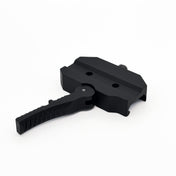
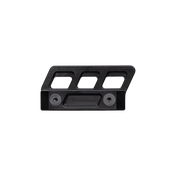
The Saturn's growing accessory line includes the Titan quick-release mount for easy on/off, the Calypso ARD for glare reduction, riser mounts, and the Piggyback Bundle. For roughly one-third the cost of an ACOG-plus-RMR configuration, you can run a complete dual-optic Cosmic Tactical setup.
Who Should Buy the ACOG TA31?
The Trijicon ACOG TA31 is the right purchase for active-duty military and law enforcement issued through unit funding, operators conducting low/no-light operations without night vision, and shooters engaging at military distances of 600–800 meters where the BDC is purpose-calibrated. ACOGs also retain resale value better than nearly any other optic on the secondary market.
- You're active-duty military or law enforcement issued optics through your unit (unit funding, not personal budget)
- You operate in pitch darkness without NVGs and need a self-illuminating reticle
- You want the most battle-proven optic ever made and budget isn't a constraint
- You shoot at extended military distances (600–800m) where the ACOG's BDC is calibrated
- Resale value matters — ACOGs hold their value better than nearly any optic on the secondary market
Who Should Buy the Saturn 4x32?
The Cosmic Tactical Saturn 4x32 is the right purchase for civilian shooters who want fixed 4x prism capability — etched BDC reticle, fiber-optic illumination, no batteries — without spending four figures. It's equally well-suited for shooters with astigmatism, .308/7.62 rifle builds, daylight-and-twilight use cases, and buyers who value the 60-day money-back guarantee.
- You want the 4x32 prism scope experience — etched reticle, fiber-optic illumination, no batteries — without spending four figures
- You have astigmatism and need an etched reticle that stays crisp (Saturn and ACOG solve this equally well)
- You're building a .308/7.62 rifle and want a caliber-specific BDC at a reasonable price
- You'd rather put the $900+ savings into ammo, training, accessories, or a second optic
- You shoot primarily in daylight and twilight where fiber-optic illumination is all you need
- You want a 60-day money-back guarantee to test before committing (Trijicon direct doesn't offer this)
- Military and first responders get additional savings on top of the $299.95 price
Frequently Asked Questions
Is the Saturn 4x32 a good ACOG alternative?
Yes. The Saturn functions as a direct ACOG alternative for civilian use cases; it shares fixed 4x magnification, etched BDC reticle, fiber-optic illumination, battery-free operation, and nitrogen-purged housing. It doesn't match the ACOG's tritium night illumination or 100-meter waterproof depth, but delivers the core 4x32 prism platform at roughly one-quarter the price.
What does the ACOG have that the Saturn doesn't?
Three things: tritium illumination (the reticle glows in total darkness without batteries), forged 7075-T6 aluminum housing (the strongest available), and 100-meter waterproof depth versus 10m on the Saturn. The ACOG also has finer turret adjustments at 1/3 MOA per click versus 1/2 MOA, and a wider field of view at 36.8 ft versus 31.5 ft at 100 yards.
Does the Saturn hold zero as well as an ACOG?
The Saturn is third-party lab certified for shock resistance and holds zero through sustained recoil from .223/5.56 and .308/7.62 platforms. Independent reviews from The Truth About Guns confirm zero retention through normal use. That said, the ACOG has been documented surviving explosive impacts and vehicle rollovers; that's a level of extreme abuse testing no civilian-market optic at any price has matched.
Can I use a Saturn for home defense?
Yes. The Saturn's 4x magnification works well for home defense distances (7–25 yards), and the etched reticle is visible with any ambient light source (including the weapon light you should already have on a home defense rifle). For a dedicated CQB setup, consider pairing it with a Mercury reflex sight in a piggyback configuration for the fastest possible target acquisition at close range.
Why is the ACOG so expensive?
Forged 7075-T6 aluminum housing, tritium handling and licensing (tritium is a controlled radioactive material), decades of military qualification testing and documentation, U.S. manufacturing with defense contractor overhead, and brand premium built on 20+ years of combat service. You're paying for military-grade materials, tritium technology, and the name. Whether that premium is worth it depends entirely on whether you need what those extras actually provide.
Saturn 4x32 vs ACOG TA31: Which Should You Buy?
The verdict in one sentence: Buy the Trijicon ACOG TA31 if you operate in total darkness without NVGs at military distances and budget is no constraint; buy the Cosmic Tactical Saturn 4x32 for every other 4x32 prism scope mission — range, hunting, competition, home defense, and astigmatism-friendly etched reticle shooting — at one-quarter the price.
The Trijicon ACOG TA31 earned its reputation the hard way: in the hands of Marines across two decades of combat. No optic in history has been more thoroughly battle-tested. If your mission demands proven performance in the most extreme conditions imaginable, including total-darkness operations without NVGs, the ACOG is worth every dollar.
But most shooters aren't clearing buildings in Fallujah. They're running drills at the range, hunting whitetail at dawn, competing on weekends, or keeping a rifle ready for home defense. For those missions, the Saturn 4x32 delivers the same fundamental capability — a compact, battery-free prism scope with a crisp etched reticle and caliber-specific BDC — at a price that leaves room for ammo, training, and accessories that maximize your scope's performance.
The $1,100 difference buys you tritium, 7075-T6 forging, and a name. If you need those things, you already know it. If you're not sure, you probably don't; the Saturn is the smarter investment.

 https://cosmictactical.com